

Mitsubishi Triton Raider 2026 Review
Mitsubishi’s tough truck is a proper crusty demon of dirt – if only the engine kept pace with its chassis


By carsales.com.au
Australia has a long history of muscle cars.
But times have changed, and the era of V8-powered, tyre-frying hot rods has shifted to high-riding, dirt-churning four-wheel drives like the new Mitsubishi Triton Raider.
It’s the Japanese car maker’s first crack at Australia’s increasingly fierce tough truck war and co-developed by the firm behind some of the country’s fastest and most powerful Ford Falcons.
Built in conjunction with Melbourne engineering firm Premcar, the company born out of Prodrive Australia that partnered with Ford Performance Vehicles, the Triton Raider rides on all-new Monroe shocks, taller springs and ROH 18-inch alloys wrapped in Bridgestone all-terrain boots – all calibrated over 40,000km of local testing.
The result is a ute that excels on high-speed gravel roads and handles slow-speed off-road work far better than its brief suggests. It drives better than its donor car on bitumen too.
The 2.4-litre twin-turbo diesel feels lazy on-road, but at $74,990, the Raider is a genuinely compelling package.
How much does the Mitsubishi Triton Raider cost?
Priced from $74,990 drive-away, the 2026 Mitsubishi Triton Raider sits at the very top of the Triton lineup – about $9000 above the GSR it’s based on.
That’s a lot of money, but here’s the rub: almost two thirds of all dual-cab ute sales in Australia right now go to hay haulers priced above $65K. That’s a staggering factoid.
So, Mitsubishi is making the decision to let Chinese brands fight at the budget end of the market and punch upward instead.
That puts it squarely in the crosshairs of the Ford Ranger Tremor ($75,090) and Isuzu D-MAX Blade ($80,900).
What standard equipment does the Mitsubishi Triton Raider feature?
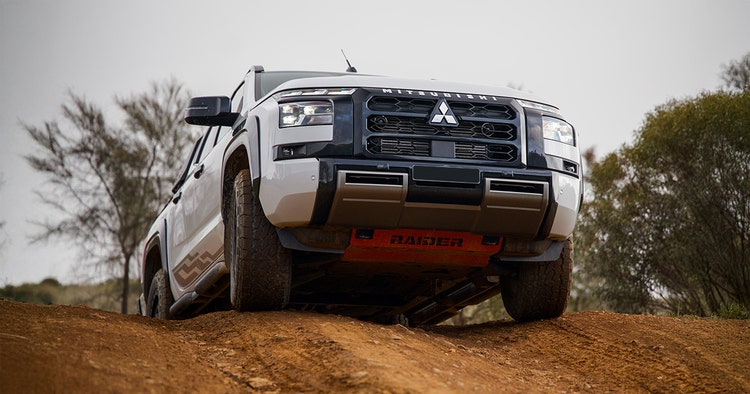
Visually, the Raider announces itself with a new front bumper, a red steel bash plate with Raider lettering, 18x9.0-inch ROH Assault alloy wheels in Brushed Bronze (although I’d call them pewter-coloured), Bridgestone Dueler AT 002 all-terrain tyres, rock sliders with side steps, a sports bar at the back and ‘Sandstorm’ side decals.
Raider branding appears on the headrests and a centre console plaque inside.
It would’ve been nice to see a few more bespoke trinkets in the cabin but that may have pushed the price north.
Four colours are on offer: white, black, grey and silver. The 3500kg braked towing capacity carries over unchanged from the standard GSR, as does the level of standard equipment that includes:
- LED headlights and taillights
- Keyless entry with push button start
- Rear privacy glass
- Leather appointed seats
- Power adjustable driver’s seat
- Heated front seats
- Climate control with rear air vents
- 9.0-inch infotainment touch screen
- Bluetooth connectivity
- Embedded sat nav
- DAB+ Digital radio
- Apple CarPlay and Android Auto
- Six-speaker audio system
- Wireless phone charger
What safety features does the Mitsubishi Triton Raider have?
It also maintains the same five-star ANCAP safety rating from 2024 thanks to the comprehensive suite of advanced safety systems and autonomous driver aids, including:
- Autonomous emergency braking
- Adaptive cruise control
- Forward collision warning
- Lane keeping assistance
- Rear collision braking
- Blind spot detection
- Driver attention monitoring
- Traffic sign recognition
- Front and rear parking sensors
- 360-degree parking display
- Mitsubishi Connect with emergency eCall function
What is the Mitsubishi Triton Raider like inside?
The donor Triton isn’t the biggest dual-cab ute in terms of cabin space, and nor is the flashiest.
In fact, its dashboard design already feels a generation behind others like the Ranger, and Chinese newcomers like the BYD Shark 6.
But it does feel extremely well built with good quality materials, and it has plenty of practical touches with good small item storage spaces throughout.
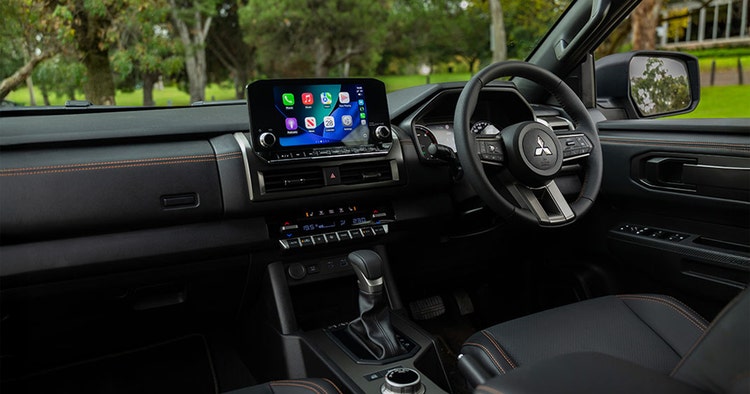
The 9.0-inch touch screen sits proudly on top of the dash which can impede some forward vision, but it also makes it easily accessible and we’re grateful it maintains physical controls for simple functions like adjusting the audio and selecting the next or previous track.
There’s also a bank of buttons for the climate control, a traditional gear lever and a rotary control for the low-range four-wheel drive system.
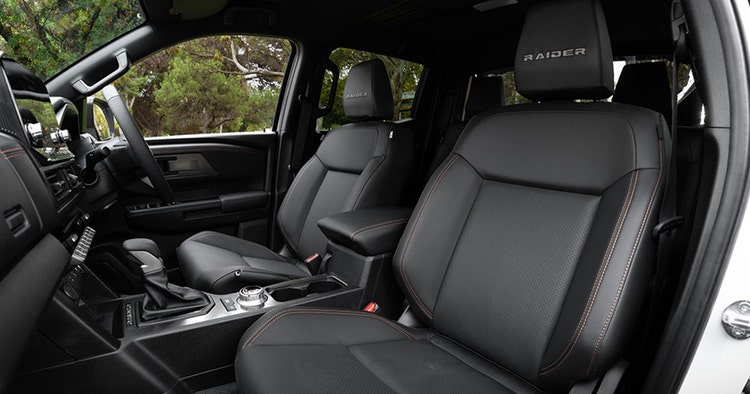
The front seats are comfortable and supportive with plenty of adjustment to suit all types of drivers, and there’s decent space for two adults in the back with roof mounted air vents and USB power outlets.
The only identifying elements that this is something beyond a normal Triton are the Raider logos embossed into the front seat headrests and the plaque stuck to the centre console in front of the gear lever.
What is under the bonnet of the Mitsubishi Triton Raider?
Like pretty much every other tough truck ute on sale in Australia today – except the Ranger Raptor – the Raider doesn’t get any powertrain upgrades.
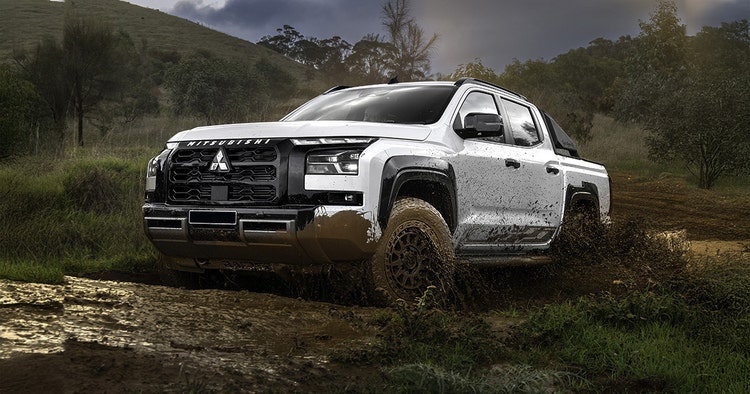
Therefore, it soldiers on with the same 150kW/470Nm 2.4-litre four-cylinder twin-turbodiesel engine offered across the Triton range.
It’s paired with a six-speed automatic and Mitsubishi’s SuperSelect II 4x4 system (2H, 4H, 4HLc, 4LLc) with a locking rear differential.
Surprisingly, considering the bigger, draggier tyres, raised suspension and extra bits and pieces hanging off the Triton Raider’s bodywork, Mitsubishi claims it has the same average fuel consumption figure of 7.7L/100km as the GSR it is based on.
What is the Mitsubishi Triton Raider like to drive?
The chassis is the star of the show. In fact, the 2026 Mitsubishi Triton Raider’s bouncy bits could be the star of the entire segment… Ranger Raptor notwithstanding.
Simply put, Premcar’s overhaul (revised front and rear springs, Monroe shocks with a larger oil capacity and bigger piston as well as Raider-specific rebound springs and redesigned bump stops) transforms the Triton’s ride and handling character.
On high-speed gravel roads, the Raider feels genuinely confident and predictable, soaking up big hits without drama and resisting body roll through corners far better than any standard ute chassis has a right to.
On bitumen it also impresses, riding flatter through corners than expected and absorbing urban road imperfections with near-car composure. The rear end is settled, and the front end feels ultra-positive.
The Bridgestone Dueler AT 002 tyres are a standout. Mitsubishi and Premcar tested four different tyre options before landing on this one, and the choice pays dividends: they provide strong grip both on gravel and sealed roads, add a useful 15mm of ride height, contribute to a noticeably heavier and more connected steering feel, and remain impressively quiet at highway speeds.
That’s a rare combination in all-terrain rubber.
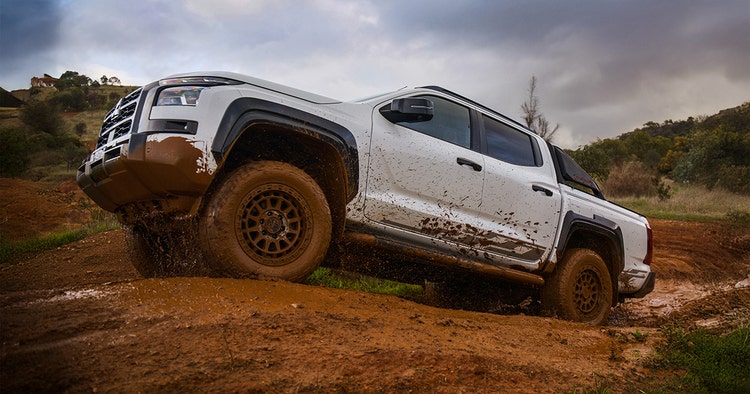
Slow-speed off-road performance also exceeded expectations given Mitsubishi’s stated brief of high-speed dirt capability, not slow rock crawling.
The 25mm of extra front ride height (+10mm from the new springs) nails approach angles, the steel bash plate adds real-world confidence, and wheel articulation is impressive.
The engine’s broad low-speed torque delivery makes it surprisingly easy to modulate on rough terrain as well, and the Super Select II 4x4 system is excellent. We did have to enter the cheat code at a few points (locking the rear diff) but for the most part the system is very savvy on the rough stuff.
Hill descent control is smooth rather than aggressive, and the traction control has been well calibrated – it thinks briefly and reapplies torque without abrupt lurching.
There’s also a simple but genuinely useful feature: a quick-access menu shortcut that kills driver attention alerts with one tap. On a long outback run, that single button will save your sanity.
However, the engine is the Raider’s most obvious weak point on-road. The 2.4-litre twin-turbo diesel (150kW/470Nm) is perfectly adequate for crawling over rocks and pulling trailers but feels uncharacteristically lazy during sealed-road overtaking.
Throttle response is slow to build, the six-speed auto is unremarkable and there’s a sense the powertrain is doing the minimum required rather than enthusiastically joining in. That could prove handy in the long run, given it feels fairly under stressed.
However, in a vehicle that otherwise feels this dynamic, you’re left wondering what a PHEV powertrain – with its instant electric torque hit – would do for the overall package?
Rivals are already moving in that direction.
There is also a meaningful caveat to the on-road driving impression. The updated 2026 Triton GSR donor car now comes standard with revised factory suspension and a Yamaha performance damper across the chassis – features we haven’t yet tested in isolation.
Until we drive both back-to-back, it’s difficult to know precisely how much of the Raider’s impressive cornering composure belongs to Premcar and how much is simply the new standard Triton doing its thing.
How much does the Mitsubishi Triton Raider cost to maintain?
Mitsubishi sets the benchmark for ownership credentials in Australia, and even though the Raider was co-developed by a third party, it maintains the same level of coverage, including a 10-year warranty if the vehicle is serviced within the dealer network.
Plus, there’s 10 years of roadside assistance on offer and a decade of capped price servicing too.
Should I lease a Mitsubishi Triton Raider?
If you regularly cover long distances on unsealed roads – or want the confidence to do so – the Triton Raider is a compelling option.
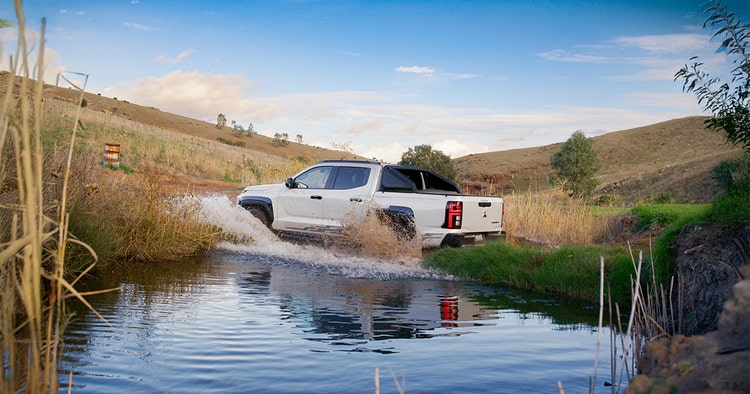
The chassis tuning is the real deal: it feels significantly more capable and more enjoyable to drive than a standard Triton both on gravel and sealed roads.
The overall package has the hallmarks of honest engineering rather than a badge-and-bodykit special. The fact you get to keep your 10-year warranty also adds appeal.
The diesel engine feels a generation behind where this chassis deserves, but the Raider elevates the Triton in the ute pecking order, without doubt.
On first impression, Mitsubishi now has a legitimate horse in the tough-truck race.
2026 Mitsubishi Triton Raider at a glance:
Editor’s Rating: 8.1/10
$74,990 (drive-away)
Now
2.4-litre four-cylinder twin-turbo diesel
150kW/470Nm
Six-speed automatic
7.7L/100km (ADR Combined)
202g/km (ADR Combined)
5-star (ANCAP 2024)
Disclaimer: Images supplied by carsales
Explore Mitsubishi Triton Novated Leasing
A Mitsubishi Triton novated lease may help eligible employees package their car and running costs into one regular payment. Learn more about Mitsubishi novated leasing, how a novated lease works, and use our novated lease calculator to estimate your potential costs and savings.