

Hyundai KONA Electric Standard Range 2026 Review
Hyundai’s smallest electric SUV offers style and substance and now comes with a very competitive price tag


By carsales.com.au
Hyundai has lowered the barrier to entry into its electrified line-up by re-shaping the price structure of its most accessible battery-powered model, the KONA.
Due in part to the recent arrival of the all-new Elexio mid-sized SUV, the South Korean car maker has repositioned the KONA electric range to be more affordable with an attractive price reduction to its entry-level Standard Range version that we’re testing here.
This second-generation model has been on sale since 2024 with a 99kW electric motor, and a 49kWh battery that’s capable of delivering 370km (WLTP) driving range, and in isolation is a comfortable and relatively spacious small SUV with plenty of tech and good dynamics.
So, how does it stack up?
How much does the Hyundai KONA Electric Standard Range cost?
The base 2026 Hyundai KONA Electric Standard Range tested here is the entry point to the KONA EV range.
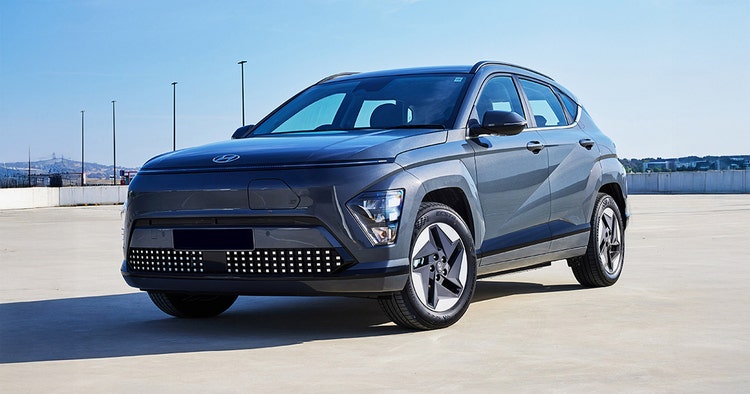
Until recently it would set you back $54,000 plus on-road costs (ORCs), but Hyundai has taken a hatchet to pricing and now offers the same vehicle for $45,990 driveaway, which amounts to around a $13,000 saving depending on the state you live in.
As before, you can get an Extended Range version for another $4,000 or the Premium (which only comes as an Extended Range) for an extra $14,000.
There are now plenty of alternatives in the class, including the Chery E5 (from $36,990 + ORCs), the Kia EV3 (from $47,600 + ORCs), the MG S5 EV (from $40,490 + ORCs) and the Nissan Ariya (from $55,840 + ORCs). The BYD Atto 3 (from $39,990 + ORCs), while classed as a medium SUV, also nudges close to KONA in size and spec.
What standard equipment does the Hyundai KONA Electric Standard Range feature?
Standard equipment on the 2026 Hyundai KONA Electric Standard Range includes:
- 17-inch alloy wheels
- LED headlights and taillights
- Vehicle to Load (V2L) functionality
- Keyless entry and push button start
- Cloth interior trim
- Dual-zone climate control
- 12.3-inch digital instrument cluster
- 12.3-inch infotainment touchscreen
- Bluetooth connectivity
- DAB+ digital radio
- Embedded sat nav
- Smartphone mirroring
- Six-speaker audio system
- Over-the-air updates
- Hyundai Bluelink connected services
The only major option is to have your KONA in a different colour to the no-cost Atlas White. For an extra $595 you can choose from Ecotronic Grey, Abyss Black, Ultimate Red, Mirage Green, Denim Blue and Meta Blue.
What safety features does the Hyundai KONA Electric Standard Range have?
Occupant safety is strong for the 2026 Hyundai KONA thanks to its seven airbags, including a front centre airbag, which led to an adult occupant protection score of 80 per cent and a child occupant protection score of 84 per cent when it was tested by ANCAP in 2023.
However, the KONA was awarded just four stars due to its vulnerable road user protection (64 per cent) and safety assist (62 per cent) scores, both below the 70 per cent threshold required for a maximum five-star result.
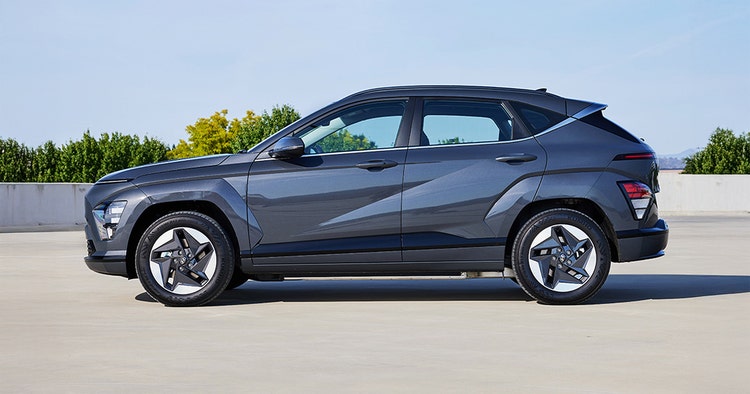
According to ANCAP, the KONA’s autonomous emergency braking was ‘adequate’ in tests with pedestrians and cyclists, while the emergency lane keeping system was also given an ‘adequate’ result.
As with most new cars, there is a long laundry list of standard active safety features. Those that rate a mention include rear cross-traffic alert, lane keeping, adaptive cruise control, blind-spot collision avoidance, driver monitoring and safe exit warning.
What is the Hyundai KONA Electric Standard Range like inside?
While the cabin is on the large side for a small SUV, the 2026 Hyundai KONA Standard Range is a little plain.
Buyers might expect a bit more flair at this price point, even when it has an expensive EV powertrain that bumps the sticker price well beyond an ICE equivalent.
Having said that, there are loads of amenities here. It’s an easy interior in which to get comfortable and to use on the daily grind, with accessible controls and instruments and loads of storage for cups, sunnies, trinkets and so on.
In the cargo space there’s 407 litres of seats-up space that increases to 1241L when rear seats are folded (plus 27 litres of storage space in the frunk).
Hyundai must be commended for fitting a space-saver spare under the cargo floor. In an age of decreasing road surface quality and increasing numbers of new vehicles with no spare wheel at all, this is a great standard feature.
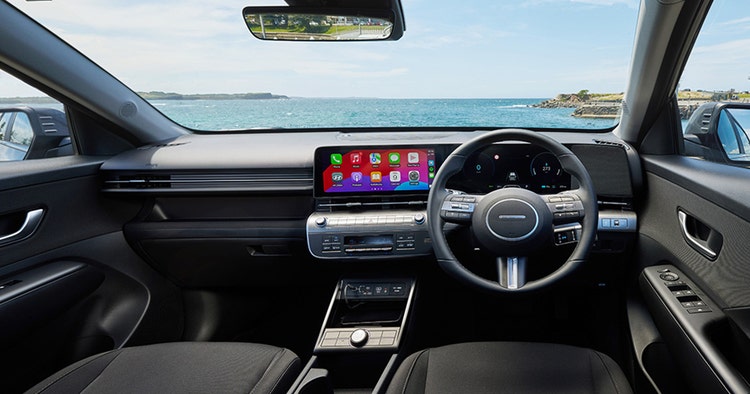
Among the tech features in the 2026 Hyundai KONA Electric are a 12.3-inch infotainment system and a 12.3-inch digital display, all encased in the same dash screen that dominates about two-thirds of the dashboard.
Hyundai Bluelink connected services via an embedded SIM give over-the-air software update capability.
Apple CarPlay and Android Auto (wireless) are integrated into the system, along with embedded satellite navigation and voice recognition.
A 15W wireless charging pad plus two USB-C data/charging ports are up front, while rear passengers get two USB-C outlets. These Type-C outlets are designed around the Power Delivery 3.0 standard, providing 27W/3A output for rapid charging.
What is under the bonnet of the Hyundai KONA Electric Standard Range?
A front-mounted permanent magnet synchronous electric motor sends 99kW/255Nm to the front wheels via a single-speed reduction gear, fed by the 2026 Hyundai KONA Electric's 48.6kWh lithium-ion battery.
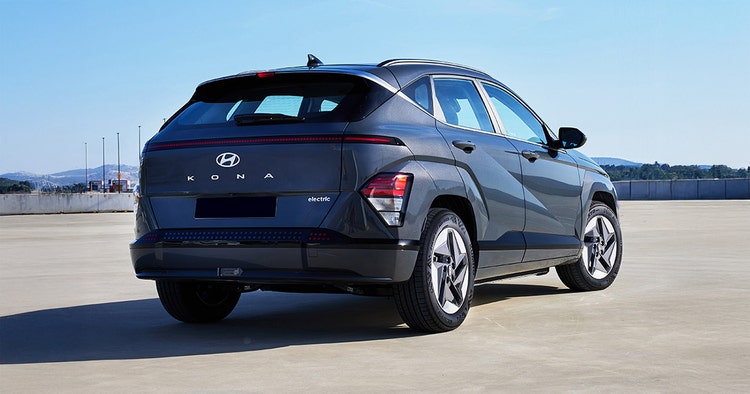
An average of 14.8kWh/100km in combined-cycle WLTP testing is the official energy consumption figure for the 2026 Hyundai KONA Electric Standard Range, with a subsequent claimed range of up to 370km.
With its Type 2/CCS2 charging port, AC charging on a standard domestic plug for a 10-100 per cent charge is 20h 40m. On 10.4kW AC charging it's 5h15min and 100kW DC charging takes about 45 minutes for a 10-80 per cent charge.
On test, we averaged 12.9kWh/100km, though the usable range displayed was only 351km. While it appeared to be quite efficient in its kWh/100km figure, the issue of range might remain a problem for those who like to use their EV often for interstate travel.
What is the Hyundai KONA Electric Standard Range like to drive?
The 2026 Hyundai KONA Electric Standard Range is much like the petrol KONA, except of course its engine bay remains silent and torque off-the-mark is instant.
With the Eco drive mode selected, the KONA is a responsive and quiet (of course) which makes it a serene method of getting around. It plugs traffic gaps easily, pulls away from corners quickly — all the kinds of low-speed response situations EVs are known to be good at.
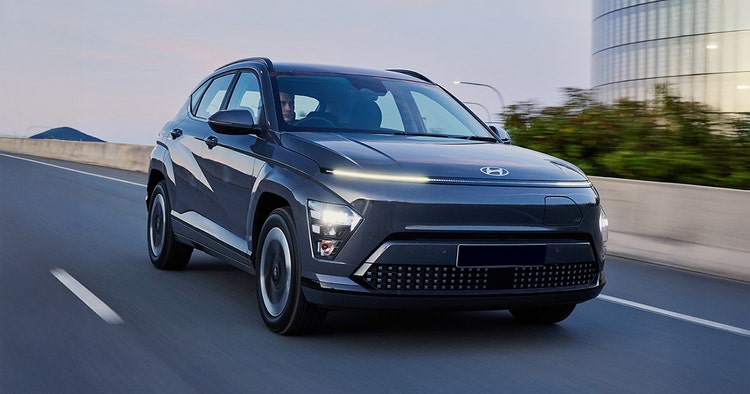
On the highway, the KONA Electric Standard Range lacks the instant response that marks its around-town behaviour. The higher grade 150kW option in the KONA Electric Premium might be the alternative you need if quick highway overtaking is one of your priorities.
This is one of the better EVs around in terms of its suspension tuning. It doesn’t provide sports car traction or driver engagement, but neither is it the lumpy, ponderous, bump-crashing experience some newcomers to market are. The turn-in response, grip, suspension composure and ride quality make this a reasonably sharp tool for carving through a twisting country road.
How much does the Hyundai KONA Electric Standard Range cost to maintain?
The KONA Electric is covered by Hyundai’s seven-year/unlimited kilometre vehicle warranty while the high-voltage battery is covered for eight years/160,000km.
Scheduled servicing is due every two years or 30,000km, with Hyundai’s capped priced servicing costing $725 at 30,000km/24 months, $747 at 60,000km/48 months and $725 at 90,000km/72 months, for a total of $2,197 over the first three visits.
Should I lease a Hyundai KONA Electric Standard Range?
The 2026 Hyundai KONA Electric Standard Range is a good electric SUV.
It gets a tick for basics such as a spacious, well packaged interior, generous tech package and good dynamics.
But the KONA Electric Standard Range lacks the crash safety score, value for money, touring range and interior fixtures appeal to claim it as the benchmark in its class.
2026 Hyundai KONA Electric Standard Range at a glance:
Editor’s Rating: 7.6/10
$45,990 driveaway
Now
75kW/128Nm (electric motor: 100kW/250Nm)
Single permanent magnet synchronous motor
Single-speed reduction gear
49kWh lithium-ion
370km (WLTP claim)
14.8kWh/100km (WLTP claim)
Four-star (ANCAP 2023)
Disclaimer: Images supplied by carsales
Explore Hyundai KONA Novated Leasing
A Hyundai KONA novated lease may help eligible employees package their car and running costs into one regular payment. Learn more about Hyundai novated leasing, how a novated lease works, and use our novated lease calculator to estimate your potential costs and savings.