

2025 Toyota HiLux Rogue 48V Review
The minimally electrified Toyota HiLux Rogue 48V ute takes a small, inexpensive but worthwhile step forward


By carsales.com.au
There’s nothing mild about the Toyota HiLux, one of Australia’s most rugged – and popular – cars.
Except this one, the second-from-the-top Rogue dual-cab four-wheel drive, which features a mild hybrid powertrain.
It’s not as advanced – or as effective at saving fuel – as rivals like the Ford Ranger, BYD Shark 6 and GWM Cannon Alpha which have a proper plug-in hybrid powertrain, but it’s a start.
So, how does it work, and what is it like? Well, let’s dig in…
How much does the Toyota HiLux Rogue 48V cost?
The Toyota HiLux Rogue sits near the top of an extensive model range underneath the flagship GR Sport, which doesn’t feature the mild hybrid system but gets a powered-up version of the venerabl 2.8-litre turbo diesel.
That model is the most expensive HiLux you can buy at $74,130 plus on-roads, whereas the Rogue costs $71,350 plus on-roads which puts it right into the mix with other lifestyle-focused rivals such as the Ford Ranger Widltrak ($69,640 plus on-roads), the Isuzu D-Max X-Terrain ($70,500 plus on-roads) and the recently facelifted Mazda BT-50 SP ($71,500 plus on-roads).
The 48V Toyota engine is also available as an option in selected 4x4 HiLux models including double cab-chassis and pick-up SR and SR5 versions.
What standard equipment does the Toyota HiLux Rogue 48V feature?
The powerplant might be the latest HiLux Rogue 48V’s headline attraction, but there are things going on elsewhere too.
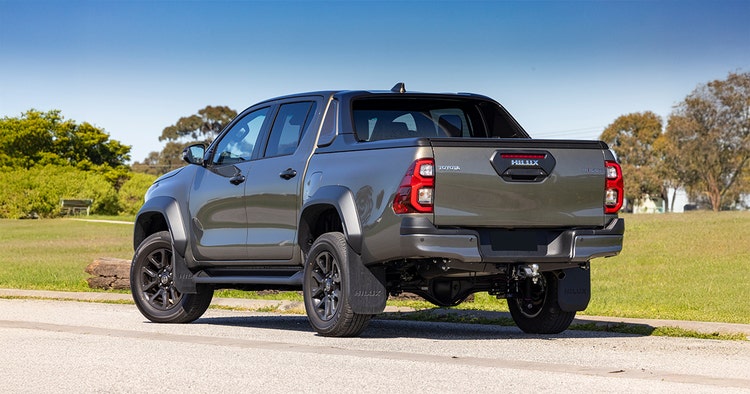
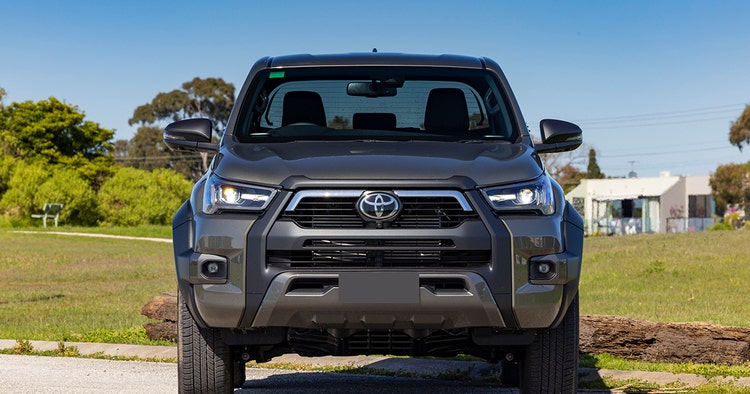
While all 48V-equipped HiLux variants get a redesigned grille and a new, universal gas-strut tailgate damper, up-spec models, including the Rogue 48V, gain splashes of gloss and matte-black finish seen on the external mirrors, door handles and around the LED headlights.
The Rogue 48V also comes with a powered sliding tray cover, a resin sailplane sports bar, a marine carpet bedliner and bespoke 18-inch alloy wheels wearing 265/60 multi-purpose tyres. The full-size alloy spare wheel is located under the tray.
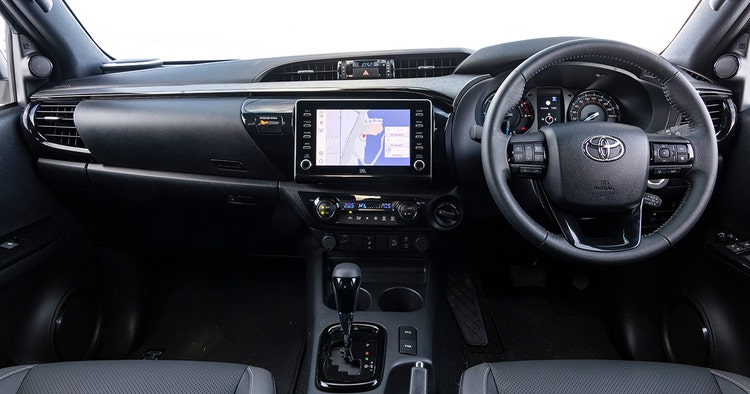
Among the trappings that maintain and enhance its glammed-up identity, the HiLux Rogue includes a decent-size centre touchscreen with satellite-navigation (but questionable camera-view clarity), a 4.2-inch multi-information display between two analogue dials, a self-dipping electrochromatic internal rear-view mirror, a punchy nine-speaker JBL sound system, part-leather door trim, and dual-zone climate control with centre vents for rear-seat passengers.
The HiLux Rogue 48V includes wired Apple CarPlay/Android Auto connectivity, USB ports front and rear, and a wireless charging pad next to the gear shifter. Two AC 220V accessory sockets are also provided.
The central eight-inch LCD screen presents as reasonably large and combines a mix of the old and the new, which in itself is not a bad thing. The analogue-style, twin-dial instrumentation has a cosy familiarity about it that contrasts with the central digital information screen, while tactile buttons for the JBL audio and climate control combine with touch-controls on the main screen.
With a pull-up handbrake, gated auto gearshift and a somewhat cluttered look overall, the HiLux Rogue is nevertheless easy to grow accustomed to – although, despite the provision of twin gloveboxes and a smallish but handy centre console bin, there’s little room left for storing random paraphernalia.
An air-conditioned cooler box located in the front of the cab is standard on all HiLux models from SR-spec upwards. The perforated, part-leather seats bring heating for both front passengers and eight-way power adjustment for the driver.
Significant options on our review Rogue 48V included a steel bullbar ($3235) and a snorkel ($697).
What safety features does the Toyota HiLux Rogue 48V have?
The HiLux Rogue 48V runs a basic list of safety technology that includes low-speed autonomous emergency braking, pedestrian and (daytime) cyclist detection, trailer sway control, lane departure warning with lane keep assist, adaptive cruise control, auto levelling LED headlights, front and rear parking sensors and three-camera bird’s-eye view parking monitors.
Blind spot monitoring and rear cross traffic alert are standard on Rogue 48V, SR5 and GR Sport, but not on other HiLux models.
The seven-airbag HiLux Rogue 48V was awarded a five-star ANCAP safety rating in 2019.
What is the Toyota HiLux Rogue 48V like inside?
The Hilux Rogue 48V is fitted out to meet the expectations of those spending more than $70,000 on what is essentially a ladder-frame chassis workhorse ute with a leaf-sprung live rear-axle.
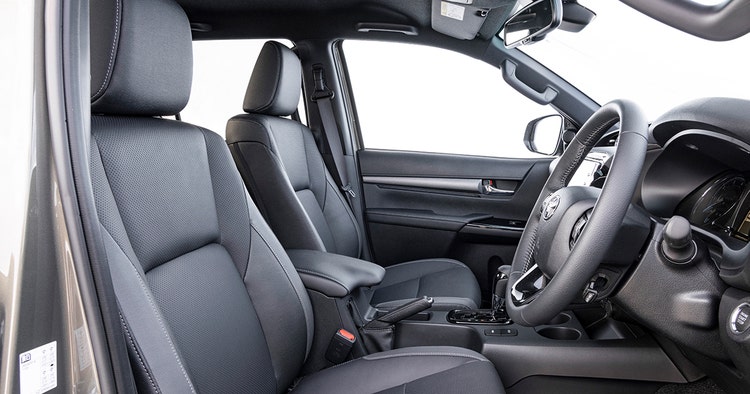
Replete with part-leather trim, a showy dash display, welcoming leather-clad seating and just about all the amenities you would expect for the price – including mood lighting in the leather-trimmed doors – the cabin feels warm and welcoming, the only downside being a lack of generosity in rear-seat legroom.
Apart from a shortage of space for incidental items up front, there are plenty of places to store drink bottles/cups in the doors and the fold-down rear armrest, while pockets behind each front seat combine with the dual gloveboxes to make available space for almost everything else.
For the money though, it would seem fair that the front passenger, not just the driver, should have a power adjusted seat.
What is under the bonnet of the Toyota HiLux Rogue 48V?
The HiLux Rogue 48V’s 2.8-litre turbo diesel’s electrically assisted attributes might sound a little underwhelming on paper, but they do improve driveability and fuel economy in real time.
A 48-volt 13-cell 4.3Ah lithium-ion battery resides under the rear seat. It’s charged by regenerative braking and sends power to a motor-generator that aids the engine with an extra 8.4kW of power and 65Nm of torque (even if it doesn’t feature in the official 150kW/500Nm engine specifications). Toyota calls it V-Active Technology.
The 48V battery also supplies the Rogue 48V’s 12V system through a DC/DC converter.
All this contributes to a lower fuel consumption than non-V-Active HiLux models, as well as more difficult-to-quantify improvements in overall engine smoothness and response – particularly at low speeds where the electric motor’s added torque kicks in to take some of the strain off the diesel engine.
Another benefit to the system’s refinement is the motor-generator’s seamless engine re-start when it’s operating in fuel-saving stop-start mode. Firing up from cold is managed by the regular starter motor.
How efficient is the Toyota HiLux Rogue 48V?
Yes, the 48-volt V-Active system brings official efficiency advantages. According to Toyota’s quoted fuel consumption figure of 7.8L/100km, it’s 7.1 per cent more fuel efficient than the regular 2.8-litre diesel’s 8.4L/100km.
Our review Rogue 48V recorded 11.1L/100km over 500km or so of non-taxing use (no payload and no more than three passengers on board) on suburban roads and freeways.
Comparing the official consumption figures with rivals such as the 3.0-litre Isuzu D-Max (8.1L/100km), 2.0-litre Ford Ranger (7.2L/100km) and the new biturbo 2.4-litre Mitsubishi Triton (7.7L/100km) shows the HiLux Rogue 48V is really only bettered by the Ranger (which is also the only one to drop below the 200g/km CO2 figure).
What is the Toyota HiLux Rogue 48V like to drive?
As a dual-range off-roader with a locking rear differential, a wider-tracked and taller stance than lower-level HiLux models, plus a generous 265mm ground clearance, the Rogue 48V is nothing fancy on smoothly surfaced roads as far as ride quality is concerned, but the steering – at 3.3 turns from lock to lock – is reasonably geared and the all-disc brakes are comforting to have.
The 48V driveline incorporates Toyota’s Multi-Terrain Select system with six selectable drive modes that tune the engine, brakes, and traction control according to specific needs in varying driving conditions.
On the road, the electrically assisted driveline’s characteristics are hard to spot, but a sensitive driver will pick the subtly improved smoothness and low-speed accelerator response, while judicious comparisons with non-electrified HiLux 2.8-litre powertrains will almost certainly reveal improvements in fuel economy.
The Rogue 48V’s 764kg payload – and its 700mm wading depth – might be down on significant others including the Ranger and D-Max, but it matches them with its 3.5-tonne towing capacity.
How much does the Toyota HiLux Rogue 48V cost to maintain?
While the HiLux Rogue 48V’s warranty is a regular five-year, unlimited-kilometre deal, roadside assist incurs an extra cost. And the servicing intervals are every six months or 10,000km, which is less than generous when compared with the 12-month/15,000km deals that are almost universal among its competitors.
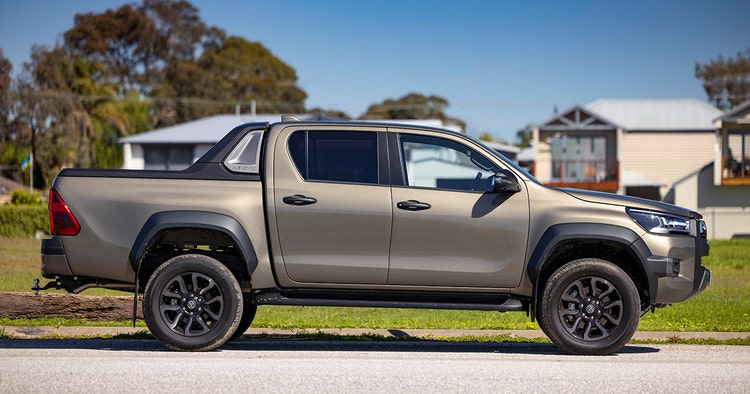
The HiLux Rogue 48V is covered by Toyota’s fixed-price Service Advantage plan with the first service kicking off at $305 and thereon averaging out to just under $800 a year.
Should I lease a Toyota HiLux Rogue 48V?
The Toyota HiLux Rogue 48V is a worthwhile improvement over the pre-electrified version and doesn’t involve a big step up in price.
The changes might be subtle but, even if the 48V engine is optionally available in other selected models, they do make the Rogue a bit more special in the way it drives and the improved economy it delivers.
The more refined HiLux Rogue should help Toyota bide its time, as it awaits the imminent arrival of its new-generation HiLux.
2025 Toyota HiLux Rogue 48V at a glance:
Editor’s Rating: 7.5/10
$71,530 (plus on-road costs)
Now
2.8-litre four-cylinder turbo-diesel
150kW/500Nm
Six-speed automatic
7.8L/100km
205g/km
Five stars (ANCAP 2019)
Disclaimer: Images supplied by carsales
Explore Toyota HiLux Novated Leasing
A Toyota HiLux novated lease may help eligible employees package their car and running costs into one regular payment. Learn more about Toyota novated leasing, how a novated lease works, and use our novated lease calculator to estimate your potential costs and savings.