

Tesla Model Y Juniper Performance 2026 Review
Performance by name, performance by nature? Tesla certainly hopes so with its latest family-friendly electric SUV

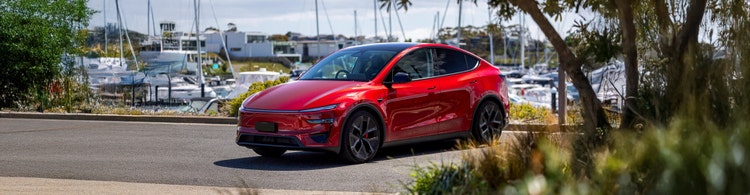
By carsales.com.au
Aussie manufacturing used to produce a bunch of automotive chameleons.
Whichever side of the Holden-versus-Ford divide you fell on, there was a family-friendly option that didn’t forgo performance.
In a roundabout way, the Tesla Model Y Juniper Performance takes that concept and thoroughly modernises it with truly bonkers electric pace.
We were left a little cold with the first iteration of the go-fast SUV, with it failing to back up the driving enjoyment or ultimate speed its halo status suggested.
So, has Tesla done enough the second time around to create the ultimate performance EV SUV for the family?
How much does the Tesla Model Y Juniper Performance cost?
What we have here is a luxury SUV that runs on electricity and is fast enough to shame some supercars in a straight line, yet can also do the school run and family holidays.
In theory, the 2026 Tesla Model Y Juniper Performance is the contemporary version of the car that can do it all. However, theory doesn’t always work in the real world – so that’s what we’re endeavouring to find out.
Right off the bat, Tesla no longer owns the fast electric SUV segment.
The Zeekr 7X Performance also adds in luxe appeal, but its $72,900 (plus on-road costs) price tag is roughly $16,500 less than the Model Y.
Still, at $89,400 (plus ORCs), the Model Y doesn’t ask as much as the venerable Hyundai IONIQ 5 N and Ford Mustang Mach-E GT.
Yet, even more surprisingly, the revamped Juniper in Performance guise undercuts the very model it replaces – and that doesn’t happen often. When it launched in early 2023 it wore a sticker price of $95,300 (plus ORCs).
If you don’t need to reach 100km/h in warp speed but still want dual e-motors and all-wheel drive (AWD), then the aptly named AWD Long Range is $68,900 (plus ORCs), while the entry-level RWD asks $58,900 (plus ORCs).
What equipment comes with the Tesla Model Y Juniper Performance?
The design department hasn’t gone crazy making the 2026 Tesla Model Y Juniper Performance look all mean and focused.
Instead, it’s abilities are hidden by relatively subtle upgrades over the standard RWD and Long Range versions, including its upsized 21-inch ‘Arachnid 2.0’ alloy wheels, carbon fibre lip spoiler on the boot lid and black mirror caps.
Otherwise, the Model Y Performance features an extensive list of standard equipment, including:
- Synthetic leather trim
- Powered front seats with heating and ventilation
- Heated outboard rear seats
- Three-zone climate control
- Ambient interior lighting
- Carbon fibre interior highlights
- 16-inch touchscreen display
- 15-speaker audio system
- Bluetooth connectivity
- Smartphone mirroring
- Embedded sat nav
- Over-the-air updates
- 8-inch rear touchscreen display
- Panoramic glass sunroof
‘Our’ Model Y is fitted with Tesla’s optional, and now operational, Full Self-Driving (Supervised). Or FSDS for short. It isn’t a cheap extra either, with a $10,100 upfront price tag or the option to pay $150 per month for your rapid SUV to drive you.
What safety features does Tesla Model Y Juniper Performance have?
The revamped range underwent crash testing this year, resulting in a five-star ANCAP safety rating being awarded.
It comes equipped with an extensive array of advanced crash avoidance systems and driver aids, including:
- Autonomous emergency braking
- Adaptive cruise control
- Lane keeping assistance
- Road sign recognition
- Blind spot monitoring
- Front and rear parking sensors
- Automated parking
- 360-degree parking display
- Full Self Driving (Supervised)
Occupants are protected by seven airbags and the back seats have dual ISOFIX points and a trio of top-tether anchorages for child seats.
What is the Tesla Model Y Juniper Performance like on the inside?
The 2026 Tesla Model Y Juniper Performance is another clear indication that the earlier days of poor build quality are largely in the past. In terms of quality control, the cabin is now hard to fault. And despite the slew of Chinese offerings adopting its minimalist design, the Tesla remains unique.
Considering this is the ‘racy’ one, it’s no surprise to see some carbon-fibre inlays to spice up the aesthetic. But other than that, this is all Juniper standard fare. Which is no bad thing.
Taller drivers will feel as though they’re perched too high – a sensation that isn’t relieved by the fact there’s a low dash and no instrument cluster.
Instead, that’s all handled by the central screen. Tasks like adjusting the steering column, side mirrors and even the gear selector require distractingly long glances at the central display.
As with a large portion of the 2026 Tesla Model Y Juniper Performance experience, you’re either going to like or dislike a lot of what’s going on here.
First and foremost, Tesla asks you to conform to how it wants you to interact with it, meaning, there’s no wireless Apple CarPlay or Android Auto compatibility here. You must use Tesla’s own proprietary operating system, which utilises Linux-based software. Teslaphiles love it, but if you’re new to the brand, taking the time to learn the ins and outs is beneficial.
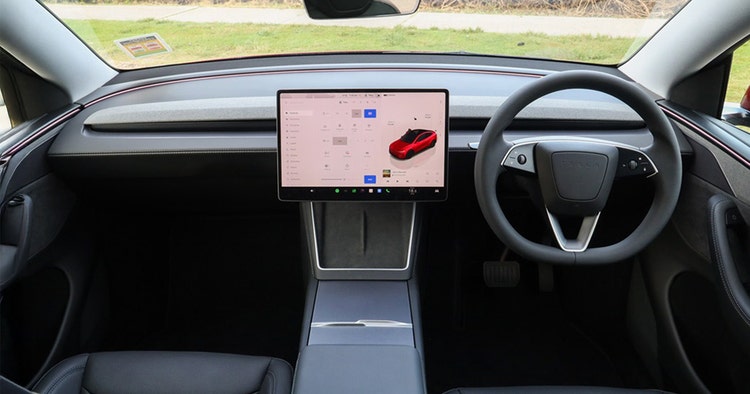
The fact you’re working with a huge – and we mean huge – 16.0-inch touchscreen makes the learning process easier. It increased from 15.4 inches with the Juniper update, with the infotainment display remaining quick in response and rich in graphics.
While it can’t quite make up for a lack of any instrument cluster or head-up display in front of the driver, the upside is a centre console bursting with storage. Trust us, its cavernous.
A meaningful addition for families is the rear-mounted 8.0-inch touchscreen. It’s placed at the back of the centre console and affords all back-seat passengers access to applications like YouTube, Spotify and Netflix (as does the dash-mounted infotainment display). There are also in-built games to play, making stops at charging stations a little less painful with kids in tow.
With double-glazed windows, it’s also a quiet place with the full panoramic glass roof generating a light and airy vibe. However, there’s no blackout blind, and while a UV-fighting coating has been applied, it isn’t robust enough to fend off an Aussie summer.
Back-seat passengers are treated to decent leg and headroom while air vents and USB-C ports make it travel friendly, too.
It’ll also swallow everyone’s luggage with an 854-litre boot, which expands to 2000L with the 40/20/40-split folding rear seats stowed.
A 117-litre ‘frunk’ affords additional space, while the fitment of a drain plug means it could also double as a camping cooler.
There’s an additional hidden storage area underneath the boot floor, but there’s no spare wheel and vision out the back is limited.
What is under the bonnet of the Tesla Model Y Juniper Performance?
The 2026 Juniper upgrade to the Tesla Model Y brings even more performance to the aptly-name flagship model.
Like before, it retains a dual motor configuration with all-wheel drive traction but now features a beefed-up version of the rear motor – lifted straight from the Model 3 Performance sedan – that produces a hefty maximum output of 461kW and 741Nm, which is a 68kW/51Nm increase over its predecessor.
When you ask for all of it at once, you better hang on because the Model Y Performance can accelerate from 0-100km/h in just 3.5 seconds – faster than many supercars.
As usual, Tesla’s figures are thin on the ground (apart from the headline-grabbing 0-100km/h time), but the Performance packs a 79kWh lithium-ion nickel manganese cobalt (NMC) battery. It’s also fitted with three main driving modes, those being Chill, Standard and Insane, which is appropriately named.
While the 2026 Tesla Model Y Juniper Performance takes the lead (quite literally) in a straight line, it’s now fighting to remain on the podium when it comes to charging.
Unlike other options using 800V architecture, the Model Y runs 400V. This means it maxes out at 250kW when using a DC rapid charger. Still, it ‘only’ takes 29 minutes to gain a 10 to 80 per cent replenishment with optimal conditions, while an AC connection maxes out at 11kW.
The Performance has 580km of driving range – 66km more than before – and its claimed average energy use comes in at 16.2kWh/100km (WLTP).
Throughout our five-day stint with the car, which included more ‘spirited’ and highway driving than city use, we returned 17.9kWh/100km.
That’s impressive considering we took it out of its slow-speed happy place, meaning it rarely used regenerative braking to recharge the battery. There are two levels of regen to choose from, Normal and Reduced, with neither being full one-pedal driving.
What is the Tesla Model Y Juniper Performance like to drive?
This generally doesn’t rate too high on the list of requirements for a family EV, but when performance is literally in the name, it must stack up. Even if it has 2033kg counting against it.
Yet just like it’s mind-bending straight-line speed, the 2026 Tesla Model Y Juniper Performance is more than up to the task of tackling the twisty bits.
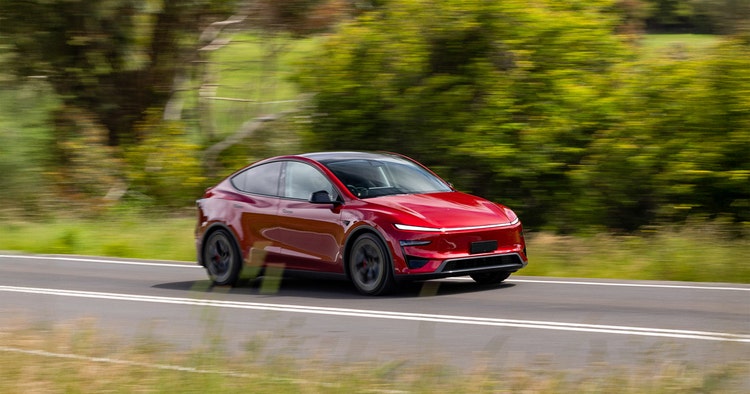
It isn’t just the dual e-motors doing all the work though, with extra aero, a 13mm cut to the ride height as well as stiffer bushings and reinforced rear suspension to aid roll control. Adaptive dampers also combine to negate the two-tonne mass.
In theory, they should also introduce some comfort into the mix considering this is an electric SUV fit for families. However, despite two modes (Standard and Sport), the ride quality always errs on the firm side. Thankfully, the shock absorbers manage rebound well and overall and it doesn’t crash over bumps.
In fact, the Model Y Juniper Performance defies its tall SUV form factor with a lowered centre of gravity. This is due to the skateboard EV architecture, where the heavy battery is positioned low, quelling roll through corners and aiding the quick changes of direction.
The chassis has a bit of help from tyre grip, too, with the Pirelli P Zero tyres also affording the Model Y with grip on turn in and traction past the apex.
While there’s a controlled rather than playful nature, with the rear e-motor being more dominant, potential moments of yaw are more likely than falling into understeer.
Even with the new reduced Electronic Stability Control (ESC) intervention, it never feels as though it’s going to come unstuck.
And that’s where the ludicrously fast Tesla disconnects – it isn’t involving enough. It’s a largely binary experience caught up in computer coding that results in a driving event that’s more SIM racer than reality.
There’s no questioning the high threshold and impressive dynamics for a go-fast SUV, but its limits are difficult to discern.
To that end, there are two main culprits. The first is the brake pedal that doesn’t inspire confidence with its wooden feedback. However, they are effective at arresting the immense pace once you give them a significant prod.
The other issue remains the steering. With the Juniper update it gains new knuckles and a retune in an effort to dial out the distinct twitchiness and hypersensitivity on centre.
And while that works to a degree, the rack ratio remains quick, with small inputs resulting in pronounced reactions.
The unusually small diameter of the steering wheel, and the fact its spokes demand your hands fall at more of a 10-and-two position, only exacerbates the odd sensation.
It’s something you must get used to, just like the rest of the cabin…
Yet, the headline act here is not how you drive it, but how it can drive itself with its Full Self Driving (Supervised) functionality.
Any way you look at it, the technology must be seen as a revolutionary feat. Yet, whether it’s fully ready is a different conversation. Let’s just say it’s about 70-80 per cent there.
It truly is a unique, odd and slightly terrifying experience. More so because it’s so at odds with everything we know about driving. However, you must be constantly attentive otherwise FSDS calls it quits – after giving you a warning. This means you won’t be updating your Instagram feed or swiping left or right behind the wheel.
Using the in-built satnav and cameras as a guide, it’s mostly accurate but it can get itself confused and make some odd moves.
FSDS has multiple personalities from the clueless tourist dithering about in unfamiliar surroundings to a Karen who’ll chop anyone off that’s in its path. When it works, it really does work. But sometimes it acts and feels too binary.
You can intervene at any point and take back the reins. If you do so, a report is sent back to Tesla of the exact situation to try and improve the system, which is heartening.
How much does the Tesla Model Y Juniper Performance cost to maintain?
In terms of warranty, Tesla recently introduced a five-year/unlimited-kilometre new-vehicle warranty in Australia, which replaces the previous (sub-par) four-year/80,000-kilometre plan.
The battery coverage meets convention with eight years or 192,000km. Servicing is condition-based, meaning the car will tell you when it needs a tune-up at the dealership.
Should I lease a Tesla Model Y Juniper Performance?
In an attempt to do it all, the 2026 Tesla Model Y Juniper Performance somewhat misses the mark.
It’s hard not to appreciate the dynamic talent, technology, performance and practicality at play here. It certainly lives up to its name. And while it might be more expensive than the new wave of EV speed, it’s a bargain compared to the ‘old-school’ combustion-engined rivals.
However, performance cars are about soul. They pull on your heart string and aren’t just a collection of figures on a spec sheet. There’s a sense that this Tesla is all about voicing the crazy numbers attached to it with other people rather than how it makes you feel while driving it.
And that’s why, if you want the Tesla that can morph itself into just about any situation, the lower grade Long Range AWD changes its colours more readily to fit a broader range of tasks. It’s the true chameleon.
2026 Tesla Model Y Juniper Performance at a glance:
Editor’s Rating: 8.2/10
$89,400 plus on-road costs
Now
Two permanent magnet synchronous motors
461kW/741Nm
Single-speed reduction gear
79kWh lithium-ion NMC
580km (WLTP)
16.2kWh/100km (WLTP)
Five-star (ANCAP 2025)
Disclaimer: Images supplied by carsales
Explore Tesla Model Y Novated Leasing
A Tesla Model Y novated lease may help eligible employees package their car and running costs into one regular payment. Learn more about Tesla novated leasing, how a novated lease works, and use our novated lease calculator to estimate your potential costs and savings.