

Kia EV5 Earth 2025 Review
Kia EV5 electric SUV set to lock horns with Tesla Model Y, Toyota RAV4 and even Kia Sportage


By carsales.com.au
The 2025 Kia EV5 is the first mainstream electric family SUV to arrive from what’s known as a legacy manufacturer.
So, it’s not a Tesla, or from any of the new Chinese brands such as BYD, XPeng, Geely or Deepal.
Sure, Kia has had a crack at EVs already with the EV6 and EV9, but they are pricey and therefore limited in their appeal.
But this one - the EV5 - is muscling in on territory occupied by family favourites like the Toyota RAV4 and, of course, its own Kia Sportage.
Let’s check it out…
How much does the Kia EV5 cost?
There are four models in the 2025 Kia EV5 range starting at $56,770 driveaway for the entry-level Air variant with a single electric motor and smaller battery pack, with a long-range version with a larger battery costing $61,170 plus on-roads.
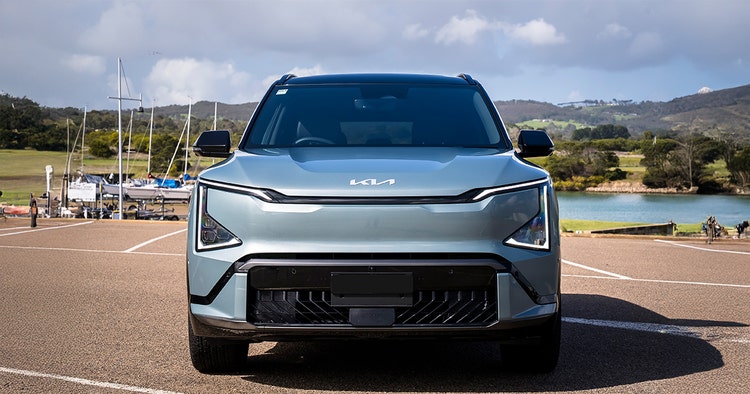
Stepping up to the Earth model we’re testing here brings a second electric motor for $71,770 plus on-roads while the range-topping GT-Line rounds out the line-up at $75,990 plus on-roads.
$64,700 plus on-road costs ($68,990 drive-away) for the entry-level Earth model-grade we're testing here.
The Kia EV5 pricing structure qualifies the EV5 for the fringe benefits tax (FBT) exemption and is intentionally positioned to undercut Australia’s dominant electric SUV, the Tesla Model Y.
The specific opposition for the Earth is the Model Y Long Range All Wheel Drive that starts at $69,900 plus on-road costs. So, the EV5 has the advantage there.
For the record, the cheapest Tesla Model Y costs $55,900 before on-road costs or around $61,000 drive-away, meaning the Kia offers sharper drive-away pricing.
But against orthodox family SUVs like the popular Toyota RAV4 Hybrid – or even Kia’s own excellent Kia Sportage – the EV5 comes with a substantial price premium.
It’s really the additional rear motor and pump-up in power and torque rather than heaps of extra equipment that distinguishes the Earth from the Air models.
What standard equipment does the Kia EV5 Earth feature?
Even the entry-level Air variants of the Kia EV5 feature an extensive list of standard equipment that includes:
- 18-inch alloy wheels
- LED headlights and tail lights
- Cloth trim with synthetic leather highlights
- Electric adjustable driver’s seat with massage function
- Heated front seats
- Power windows
- 4 USB-C power outlets
- 12V power outlet
- LED interior lighting
- Dual-zone climate control with rear air vents
- 12.3-inch digital instrument cluster
- 5.0-inch climate control monitor
- 12.3-inch infotainment touchscreen
- Six-speaker audio system
- Bluetooth connectivity
- Wireless smartphone mirroring for Apple and Android devices
- Embedded satellite navigation
- Over the Air (OTA) updates
- Kia Connect telematics
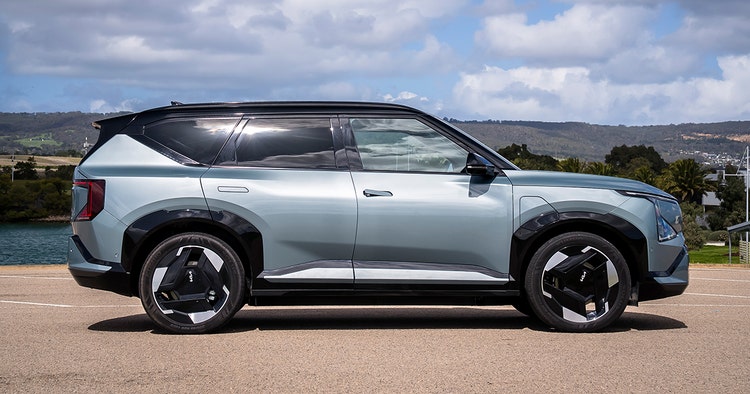
The Earth model adds:
- Larger 19-inch alloy wheels
- Synthetic leather trim
- Gloss black exterior highlights
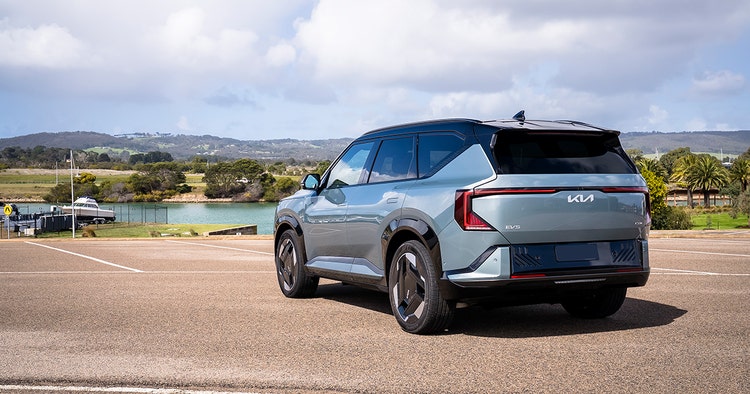
- Power-operated tailgate
- Privacy glass
The flagship GT-Line adds:
- Larger 20-inch alloy wheels
- Two-tone synthetic leather trim
- Electric adjustment passenger seat with massage function
- Premium relaxation driver’s seat with memory function
- Heated and ventilated front seats
- Heated rear outboard seats
- Auto-flush door handles
- Dynamic turn indicators
- Panoramic sunroof
- Premium three-spoke, heated steering wheel
- Fingerprint authentication module
- 64-colour ambient interior lighting
- Wireless phone charger
- Rear seat fold-down table
- Premium eight-speaker Harmon/Kardon audio
- Augmented reality head-up display
What safety features does the Kia EV5 Earth have?
All versions of the Kia EV5 score a maximum five-star ANCAP safety rating under the latest – and most stringent – testing protocols and are equipped with a comprehensive suite of advanced driver aids and crash avoidance systems, including:
- Autonomous Emergency Braking (AEB) with pedestrian and cyclist detection
- Adaptive cruise control with stop&go
- Lane keeping assistance
- Blind spot collision avoidance
- Safe exit warning
- Driver attention monitoring
- Traffic sign recognition with speed limit assist
- Front and rear parking sensors
- Automatic headlights
- Rain-sensing wipers
- Tyre pressure monitors
- Reverse parking display
- Seven airbags
The GT-Line comes with a few extra conveniences, including automated parking, a 36-degree parking display with blind spot view monitors and powered child-proof rear door locks.
What is the Kia EV5 Earth like inside?
It’s not the driving that’s makes the most profound first impression about the EV5 anyway – it’s the way it utilises the space within its cabin.
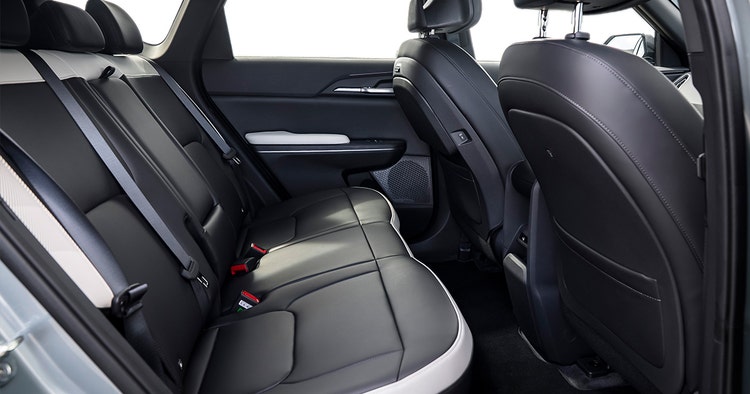
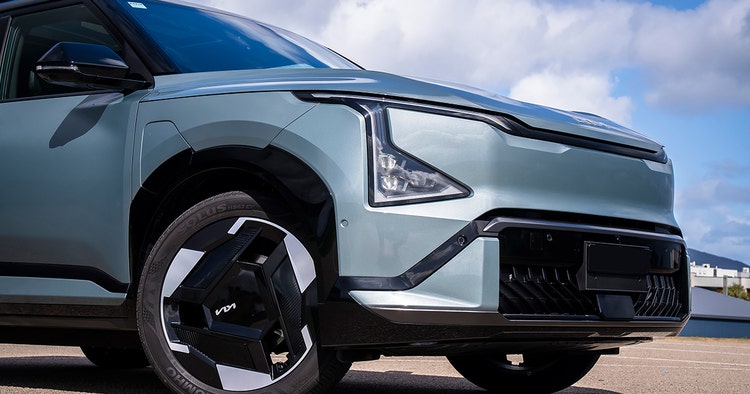
It might look like a brick on wheels – or if you prefer a mini-me Kia EV9 – on the outside, but that helps to maximising room to sit passengers, especially in the rear seat, and store stuff inside.
It’s generously open and airy back there for two tall passengers and three at a squeeze.
It’s great how they get looked after with lots of places to stow stuff including a slide-out storage box hidden in the base of the centre console.
There are also air-con vents in the B-pillars, USB-C outlets in the middle of the front seatbacks and a recline function for the rear seatbacks.
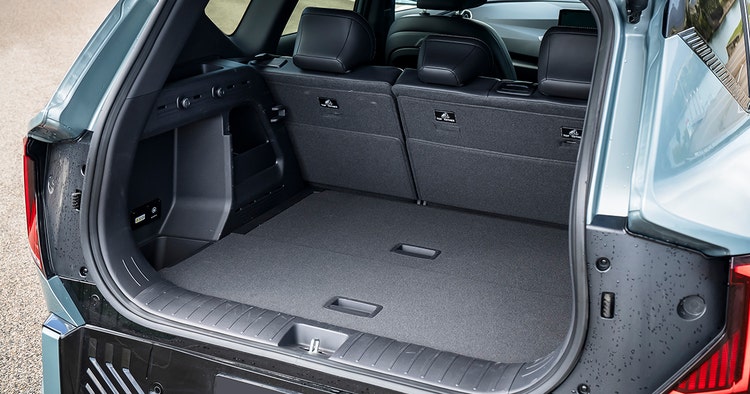
Head to the boot and there’s a reasonably large 513 litres of space on offer before the seats are folded flat into the floor, which expands the area to 1713 litres. The additional storage space under the bonnet – or the frunk - adds a useable 25 litres, which enough for a backpack or a couple of laptop bags.
Nice touches in the boot include storage nooks and crannies on the sides and under the floor, adjustable luggage hooks and movable floorboards that enable luggage to be more securely transported.
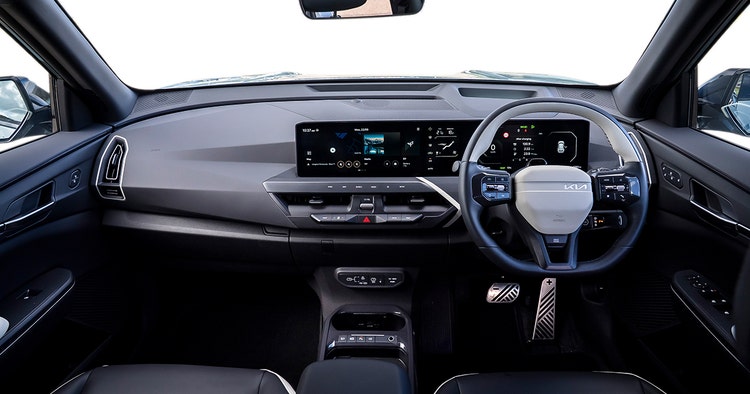
Up-front there are more good ideas; a double-stacker tray between the seats provides plenty of room for phones, wallets etc.
Meanwhile, an extension of the passenger-side cushion suggests the bench seat has made a return, but instead it houses a sleeve to securely stow phone and keys.
For all the space in the EV5 Earth and the clever storage ideas, the interior still comes across a bit low-rent for a $70,0000 car.
There are lots of hard surfaces and that’s a reflection of how much of the budget the battery pack swallows.
The upside is many of the trims are environmentally friendly-ish.
Thankfully, there are controls that sit on those surfaces to help with basics like air-con and volume adjustment. But it doesn’t help that the primary climate control screen is hidden from the driver by steering wheel.
Also, haptic touch spots on the dashboard can be triggered accidentally as you reach across them to tap the screen.
That – tapping the screen – sadly happens often, because the EV5 still has the endlessly annoying overspeed and driver attention bing-bongs and audio alerts that have to be switched off each time the EV5 is started. This is an issue faced by many modern cars aiming for a five-star ANCAP rating.
The long press fix that is making its way through Hyundai-Kia’s phalanx of models should eventually reach the EV5.
What is under the bonnet of the Kia EV5 Earth?
The Kia EV5 is available with three powertrain configurations.
The entry-level Air has a single electric motor that produces 160kW of power and 310Nm of torque and drives the front axle through a single speed transmission.
The standard range version has a 64.2kWh lithium iron phosphate battery pack that provides 400km of driving range and can be replenished between 10-80 percent on a 50kW DC charger in 57 minutes, or 36 minutes on an ultra-rapid 350kW charger.
The Air can also be had with a Long Range variant that uses a larger capacity 88.1kWh battery that has a faster 11kW AC inverter for quicker charger at home but takes longer on a DC charger (72min at 50kW and 38min at 350kW). However, it compensates with the longest driving range at 555km on a single charge.
Both the Earth we’re testing and the flagship GT-Line share the same twin-motor set-up that produces a combined maximum output of 230kW and 480Nm and use the larger battery pack to deliver respective estimated driving range figures of 500km and 470km.
What is the Kia EV5 Earth like to drive?
The family-orientation of the EV5 continues in the way it drives.
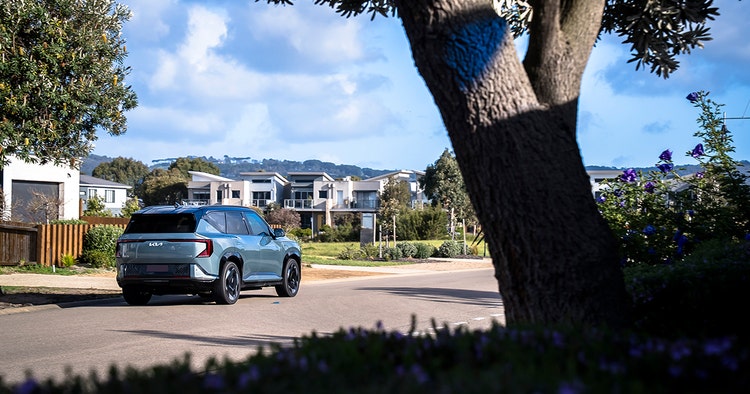
There is a real emphasis on comfort and quietness here as it rides well at any speed, which is a sound achievement considering the quoted 2198kg tare weight and low-ish profile (read: sporty) tyres.
As is normal for Kia models, the EV5 has its own localised suspension and steering tune and, based on our experience at the launch, the dual motor is a better balanced and more enjoyable drive than the single motor, which is prone to front-wheel drive steering wheel tug (torque steer) under acceleration and deflection over bumps (kick back).
The powertrain has smooth, strong acceleration from tip-in throttle to well beyond 100km/h. So, it’s great around town and very good for overtaking.
It’s worth noting there’s more than enough grunt in the most energy-saving eco mode, but that runs the car almost exclusively in front-wheel drive.
Normal mode is punchy and Sport is a bit aggro and both are all-wheel drive. Which means the juice gets drained quicker.
Having said that, the 88.1kWh battery pack impresses in how quickly it claws back energy.
The EV5 Earth has driver-selectable regenerative braking that escalates all the way to a true one-pedal mode. But the set and forget 'auto' mode works very well.
However, the flipside of that regenerative ability is merely passable range and recharging speed.
A good long drive in the EV5 Earth and time on some ultra-fast DC chargers shows it lacks Tesla-like powertrain efficiency.
The consumption claim is 20.1kWh/100km (WLTP), which is okay. But the reality is more like 23-25kWh/100km in the driving we conducted. The range claim is 500km but based on our experiences, 350-400km is about as far as you safely bet on without hypermiling.
Having said that, we haven’t driven the EV5 Earth in endless urban stop-start traffic, which should be where it’s at its most economic.
And recharging? The battery pack is rated at a maximum recharge rate of 140kW (and 11kW AC).
We actually saw 150kW during one recharging session starting with a 15 per cent state of charge. But another time on another 350kW DC fast-charger starting with the same state of charge (SOC) it never climbed over 119kW.
Compare that with the 200kW-plus that many EVs including the dual motor Model Y offer and it's slightly behind the eight ball.
The EV5 is limited in part because it has a 400-volt architecture which slows its charging rate. But LFP does charge faster than NMC (nickel-manganese cobalt) and you can charge to 100 per cent without hurting battery life, unlike NMC. So, it’s swings and roundabouts.
How much does the Kia EV5 Earth cost to maintain?
The EV5 range comes with the usual seven-year/unlimited kilometre Kia warranty, plus seven year/150,000km battery warranty. Service intervals are 12 months/15,000km and the capped price servicing currently (October 2024) rolls out at $980 for three years, $1535 for five years and $2431 for seven years.
Should I lease a Kia EV5 Earth?
The Kia EV5 Earth appears to have overcome its delayed to start to arrive in Australia as a pretty convincing electric family SUV.
It’s spacious, comfortable to ride in and well-appointed. The powertrain has its positives – acceleration strength, ease of use and quietness – while its range and efficiency are less impressive.
Against the Model Y, the EV5 is price-competitive, so it seems the mighty Tesla has some serious competition.
But the chances of coaxing buyers out of orthodox SUVs would seem to be limited at this money. The Kia EV5 certainly is another step in the right direction for EVs, but maybe not the giant leap we hoped for.
2025 Kia EV5 Earth at a glance:
Editor’s Rating: 7.5/10
$64,700 (plus on-road costs)
Now
Single permanent magnet synchronous motor
230kW/480Nm
Single-speed reduction gear
88.1kWh lithium iron phosphate (LFP)
500km (WLTP)
20.1kWh/100km (WLTP)
Not tested
Disclaimer: Images supplied by carsales
Explore Kia EV5 Novated Leasing
A Kia EV5 novated lease may help eligible employees package their car and running costs into one regular payment. Learn more about Kia novated leasing, how a novated lease works, and use our novated lease calculator to estimate your potential costs and savings.