

2025 Hyundai SANTA FE Elite Review
New turbo four engine adds extra punch to South Korean family soft roader.

By carsales.com.au
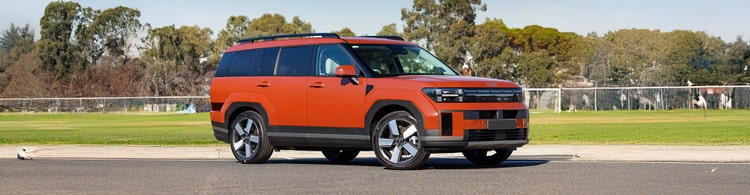
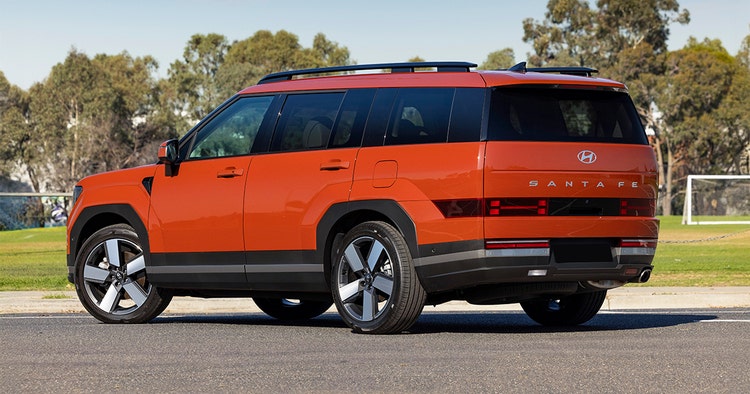
Hyundai took a bold styling path when it launched its fifth-generation SANTA FE SUV in mid-2024.
Although a bit smaller than a Toyota Kluger or Ford Everest, the new SANTA FE actually appears bigger than it is thanks to an optical illusion of its big boxy design.
But there’s no trickery when it comes to its spacious cabin, which retains three rows of seats but is more flexible and looks better than ever before while jammed full of the latest in creature comforts and conveniences.
It’s a car that puts the family first in many ways, so let’s check it out.
How much does the Hyundai SANTA FE Elite cost?
Hyundai offers eight variants of the new-generation SANTA FE across three trim levels and with the choice of either two powertrains, a 2.5-litre turbocharged four-cylinder or a 1.6-litre turbo petrol-electric hybrid.
Half of those are made up by the base-grade eponymous SANTA FE, which can be had with either powertrain linked to either a front-drive or all-wheel drive transmission, with prices starting at $53,560 plus on-roads for the 2WD petrol or $3000 more for all-wheel drive.
Both the mid-grade Elite and range-topping Calligraphy specifications are restricted to all-wheel drive no matter which engine option you choose.
We’re testing the regular SANTA FE Elite with the petrol engine that costs from $63,150 plus on-roads, which sits right in the sweet spot of the large SUV segment between the bookmarks of no-frills and genuine luxury.
There are plenty of seven-seat challengers for the SANTA FE, split close to evenly among similarly conceived soft-roaders (Toyota Kluger, Mazda CX-80, Kia Sorento) and heavy-duty ute-based wagons (Ford Everest, Mitsubishi Pajero Sport, Isuzu MU-X).
Clearly, the SANTA FE’s realistic competition comes from the first, more refined and purpose-built group.
What standard equipment does the Hyundai SANTA FE Elite come with?
Hyundai is no longer the cheap-and-cheerful car company it once was and, as the SANTA FE proves, is now a genuine pioneer in new technology with its own visual identity.
The mid-spec Elite comes equipped with a generous list of standard equipment that includes:
- 20-inch alloy wheels
- LED headlights and tail lights
- Hands-free electric tailgate
- Digital key
- Rear privacy glass
- Leather trim
- Suede headlining
- Power adjustable driver and passenger seats
- Heated front seats
- Dual wireless charging pad
- Dual-zone climate control with rear vents and third-row controls
- 12.3-inch digital instrument cluster
- 12.3-inch infotainment touchscreen
- Bluetooth connectivity
- DAB+ digital radio
- Wireless Apple CarPlay and Android Auto
- Embedded satellite navigation
- 12-speaker Bose audio system
What safety features does the Hyundai SANTA FE Elite come with?
All SANTA FE models are equipped with the same level of advanced safety and crash avoidance systems under the umbrella of Hyundai SmartSense, including:
- 10 Airbags
- Autonomous emergency braking (AEB)
- Adaptive cruise control with stop and go
- Lane keeping assistance
- Blind spot monitoring
- Driver attention monitoring
- Rear cross traffic alert and braking
- Safe exit assist
- Speed sign recognition
- Tyre pressure monitoring
- Front and rear parking sensors
- 360-degree parking display
- Remote parking assistance
Importantly, the SANTA FE provides airbag protection for occupants in all three rows and scores a maximum five-star ANCAP safety rating under the latest protocols.
What is the Hyundai SANTA FE Elite like inside?
The SANTA FE’s cabin feels big and airy, especially with our test car’s bone-white leather trim and is further amplified by the shower of light coming through the large panoramic sunroof.
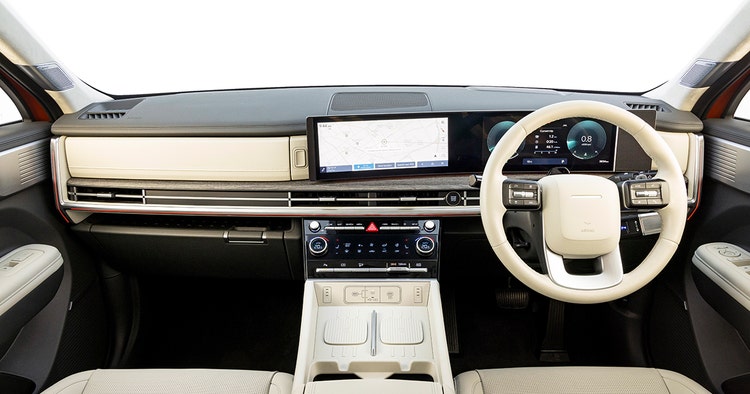
The overall design is modern and classy with high quality materials and soft touch surfaces throughout.
The twin phone charging pads take pride of place in the front console and there’s a decent-size centre bin that cleverly hinges at either the front or rear to enable use by front-seat and mid-row passengers. There are also two small gloveboxes, separated between upper and lower by a handy slot for papers or leaflets.
While the majority of functions are controlled via the infotainment touchscreen, Hyundai’s operating system has a logical menu structure that is easy to navigate.
Those in the comfortable and supportive front seats are provided with a commanding view of the road ahead and plenty of adjustment options to find the optimal seating position.
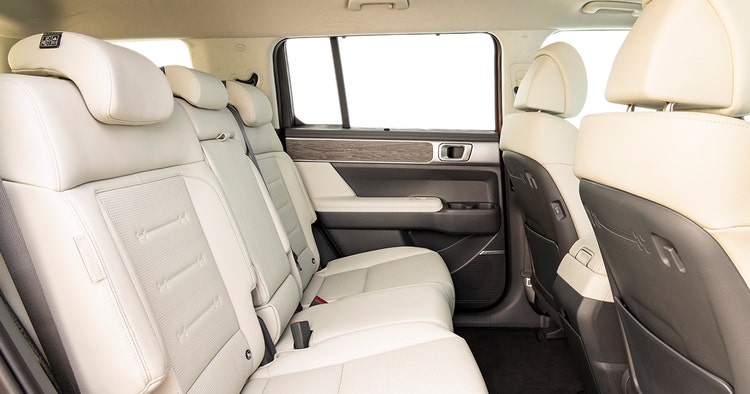
Second-row occupants are treated to a generous amount of space with excellent head and legroom, as well as face-level air vents in the B-pillars and USB power outlets to keep mobile devices charged.
Access to the third row is power-assisted and easy, though taller adults may have some difficulty extricating themselves through the confined foot spaces between the folded-forward seat cushions and the door openings.
Sliding the centre-row seats back into place is relatively easy provided the SANTA FE is not parked on a steep uphill slope.
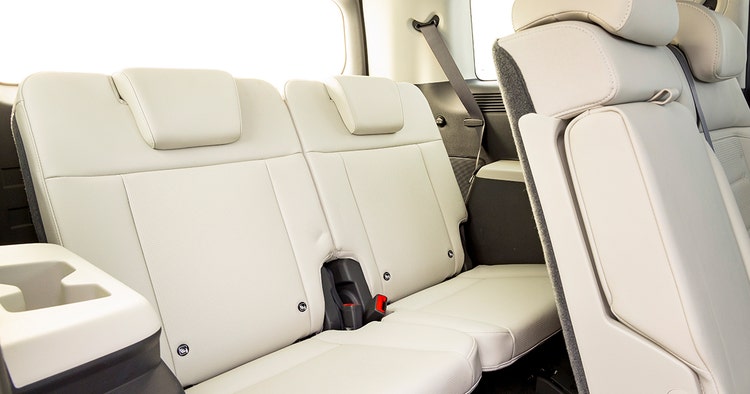
While legroom is restricted in the back-back, making it best suited to small children, the thick cushions are wide enough so they’re not banging shoulders.
The powered tailgate opens up to reveal a generous load area that begins at 642 litres and opens up to a mighty 1963L with the second and third-row seats folded down.
What is under the bonnet of the Hyundai SANTA FE Elite?
The SANTA FE Elite’s 2.5-litre long-stroke four-cylinder turbo-petrol joined the previously hybrid-only SANTA FE range in 2024 as an unmitigated powerhouse.
It produces no less than 206kW, backed up by a sturdy 422Nm of torque that’s available from a leisurely 1700rpm.
Coupled with the efficient eight-speed dual-clutch auto transmission, this makes for a handy set of legs either in urban traffic or on the open road, the output having no trouble coping with the SANTA FE Elite’s hefty 2024kg kerb weight.
The on-demand AWD driveline can be set in Eco, Normal, Sport and self-governing My Drive modes and, for minimally challenging off-bitumen adventures, in multi-terrain modes including Snow, Mud or Sand.
How fuel efficient is the Hyundai SANTA FE Elite?
With those power figures, it’s to be expected that the non-hybrid 2.5-litre turbo engine can’t match the fuel economy of the petrol-electric models, which have a remarkable claimed average consumption of 5.6L/100km.
Against the official ADR Combined consumption figure of 9.1L/100km, our review SANTA FE Elite averaged 10.8/100km, putting it at a disadvantage against the Toyota Kluger hybrid, the diesel Ford Everest Ambiente and the also-diesel Kia Sorento Sport+.
This is especially so considering the Hyundai’s 67-litre fuel tank, which is more suited in terms of range to a hybrid than an energetic 2.5-litre turbo-petrol.
What is the Hyundai SANTA FE Elite like to drive?
If the hybrid Hyundai SANTA FE impresses with its efficiency, the turbo-petrol Elite does an awfully good job of making light of its two-tonne-plus weight.
Its 422Nm might not quite match the turbo-diesel Kia Sorento’s 440Nm or the (much heavier) Everest’s 500Nm, but there’s a clear power-to-weight advantage which serves it well on the open road. An indicative zero to 100km/h acceleration time of around 6.8 seconds is pretty swift for a two-tonne, seven-seat SUV with few performance pretensions.
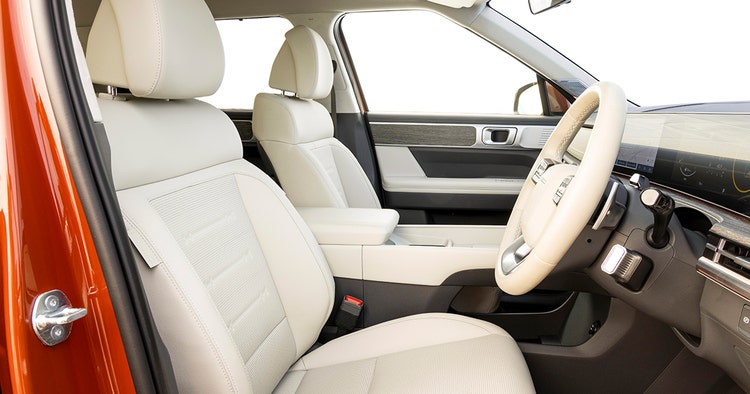
The steering is similarly unfazed by the SANTA FE’s size and weight. It’s quite quick at 2.6 turns from lock to lock and the 255/45 R20 tyres are assertive enough to help shrink the driver’s perceptions of the bulk and weight being dealt with.
The SANTA FE Elite also feels luxuriously hushed inside - equally as quiet under way as the hybrid versions – and it rides with a controlled, absorbent smoothness that cannot be matched by ladder-frame, live-rear-axle contemporaries. It copes well with undulating, tight and patchy country roads.
But the SANTA FE Elite is not a rugged four-wheel drive wagon like those ute-based rivals such as the Everest, Toyota Fortuner and Isuzu MU-X.
With unitary body construction, limited 177mm ground clearance and an AWD system designed to keep the vehicle on the road rather than off it, any attempt at tackling a bush track should be carefully considered beforehand. The standard Sand, Mud and Snow AWD modes are more a pretence than a reality.
That’s not say there’s no scope for adventure: the SANTA FE 2.5-litre’s 2000kg towing abilities are better than the hybrid versions, which are limited to 1650kg.
How much does the Hyundai SANTA FE Elite cost to maintain?
The SANTA FE comes with a standard five-year, unlimited-kilometre warranty that can be extended to seven years if the vehicle is serviced according to its prescribed schedule within the Hyundai dealer network.
On top of that, Hyundai provides the first 12 months of 24/7 roadside assist.
Fixed-price servicing intervals are set at 12 months or 15,000km for the five years of warranty with all except the $569 third service set at $459.
For an added cost, Hyundai offers lifetime servicing and premium roadside-assist plans.
Should I lease a Hyundai SANTA FE Elite?
Although the SANTA FE could be seen as a visually polarising presence in the sub-$80,000 large SUV segment, there’s an appealing and undeniably fresh look about it that is backed up by its overall refinement, versatility and practicality.
The general balance of ride and handling is sharp enough not to deter drivers who might be intimidated by its apparent size, and the 2.5-litre turbo engine delivers solid accelerative thrust that’s only disadvantaged by its thirst for (thankfully 91 RON) fuel.
The hybrid version of the Elite is not exactly a sluggard itself and delivers significantly better economy but adds an extra $4000 to the up-front costs which would take some time to recover.
With those things in mind, it’s easy to like the 2.5-litre SANTA FE Elite.
Its credentials as a soft-road SUV bring more refinement in urban conditions than ute-based seven-seat rivals like the Ford Everest and Isuzu MU-X and, for most, that’s a good thing.
The extra fuel costs are really the only detriment.
2025 Hyundai SANTA FE Elite at a glance:
Editor’s Rating: 7.8/10
$63,150 (plus on-road costs)
Now
2.5-litre four-cylinder turbo-petrol
206kW/422Nm
Eight-speed dual-clutch automatic
9.1L/100km
212g/km
Five-star (ANCAP 2024)
Disclaimer: Images supplied by carsales.
Explore Hyundai SANTA FE Novated Leasing
A Hyundai SANTA FE novated lease may help eligible employees package their car and running costs into one regular payment. Learn more about Hyundai novated leasing, how a novated lease works, and use our novated lease calculator to estimate your potential costs and savings.