

2025 GWM Haval H6 Ultra Hybrid review
Chinese brand has revised its mid-sized SUV, but has it ironed our all the wrinkles?


By carsales.com.au
The Haval H6 is the most critical model in GWM’s lineup, simply because it plays in the most competitive segment of the Australian automotive landscape.
It’s important because if it gets the mid-sized SUV formula right then it casts a positive light over the rest of the range.
Which is why GWM has given it another nip and tuck for 2025 with a raft of cosmetic and mechanical upgrades – and a price adjustment – to stay sharp against an ever-growing list of budget-friendly alternatives.
Plus, with the recent arrival of the fuel-sipping plug-in hybrid, there’s even more reasons to consider the Haval H6.
So, let’s take a look at the mid-spec version with a conventional petrol-electric powertrain, the H6 Ultra Hybrid.
How much does the GWM Haval H6 Ultra Hybrid cost?
Haval offers the mid-sized H6 with a choice of three powertrain options, a standard internal combustion engine, a conventional series-parallel hybrid and the new plug-in hybrid.
Each of them is available in either entry-level Lux or top-grade Ultra trim levels, with buyers able to choose between front- or all-wheel drive in the latter with either of the petrol-electric powertrains.
That means there is a total of eight model variations, with prices starting at $35,990 driveaway for the entry-level, petrol-powered Lux and topping out at $50,990 driveaway for the flagship Ultra PHEV with all-wheel drive.
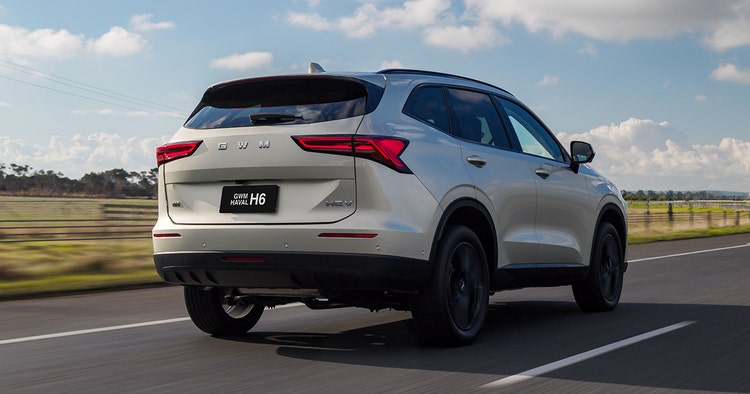
The Ultra trim commands a $3000 premium across the range, while all-wheel drive adds $3500 to the cost of the Hybrid but only $3000 to the PHEV.
The version we’re testing here – the front-drive GWM Haval H6 Ultra Hybrid – sits right in the middle of the range, and the meatiest part of the medium SUV segment, with a $43,990 driveaway price tag.
What standard equipment does the Haval H6 Ultra Hybrid feature?
GWM isn’t stingy when it comes to standard equipment, with the Haval H6 Ultra Hybrid fitted with a long list of features and creature comforts including:
- 19-inch alloy wheels
- Electric automated tailgate
- Keyless entry and push button start
- Rear privacy glass
- LED headlights and tail lights
- Ambient interior lighting
- Dual-zone climate control with rear air vents
- Panoramic sunroof
- Heated steering wheel
- Wireless charging pad
- Synthetic leather trim
- Electric adjustment for driver and passenger seat
- Heated and ventilated front seats
- 10.25-inch digital instrument cluster
- 14.6-inch infotainment touchscreen
- Bluetooth connectivity
- Voice command
- Wireless Apple CarPlay and Android Auto
- Eight-speaker audio system
- Head-up display
What safety features does the Haval H6 Ultra Hybrid have?
All variants of the Haval H6 range are equipped with a comprehensive suite of advanced safety systems and driver aids including:
- Seven airbags
- Autonomous emergency braking (AEB)
- Adaptive cruise control with traffic jam assist
- Lane keeping assistance
- Rear cross traffic braking
- Traffic sign recognition
- Blind spot monitoring
- Door opening warning
- Driver attention monitoring
- Rear parking sensors
- 360-degree parking display
- Tyre pressure monitoring
The Ultra petrol and front-drive Hybrid model also pick-up front parking sensors with automated parking assistance which can not only autonomously steer the car into a perpendicular or parallel parking spot, but can also memorise the path taken prior to coming to a halt and repeat it in reverse, which can be handy if you’ve had to negotiate a tight driveway.
The Haval H6 (excluding the PHEV models) achieved a five-start ANCAP rating from 2021 when it was first launched in Australia with high individual marks for adult and child occupant protection and safety assist.
What is the Haval H6 Ultra Hybrid like inside?
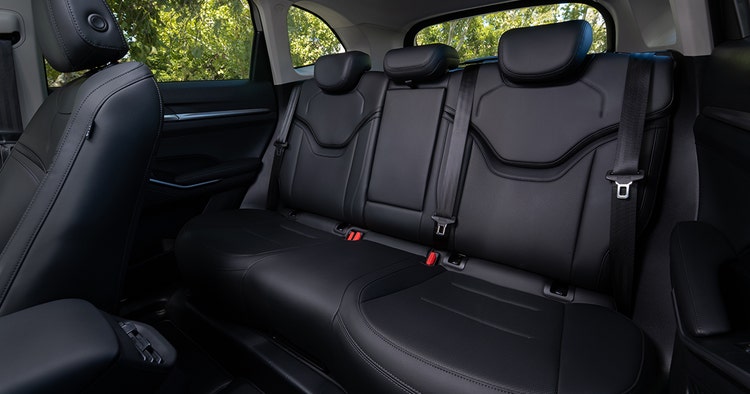
The current generation has always been strong value, and a great choice for those looking for an SUV with a spacious back seat. With the arrival of the facelifted 2025 Haval H6 Ultra hybrid, it’s now got a cabin that’s even more user-friendly.
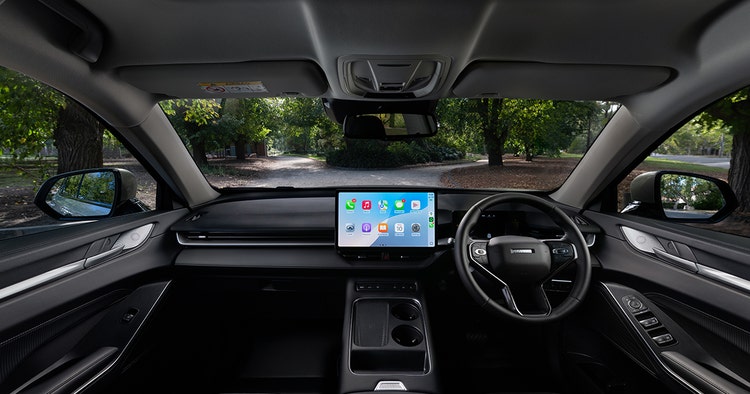
That’s largely due to the overhaul of the centre console. By relocating the transmission selector to the steering column, the wireless phone charging pad has migrated closer to the occupants and is easier to access as a result.
The cupholders fall naturally to hand, too, while there’s an additional tray for keys and wallets – the under-console storage cubby is larger as well.
Besides that, the designers have also eliminated all ‘piano black’ trim from the cabin. Piano black – that hard gloss black plastic that tends to mark easily with scratches and grease – is a scourge on the industry, and it’s pleasing to see that GWM has relegated it to its rightful place: the bin.
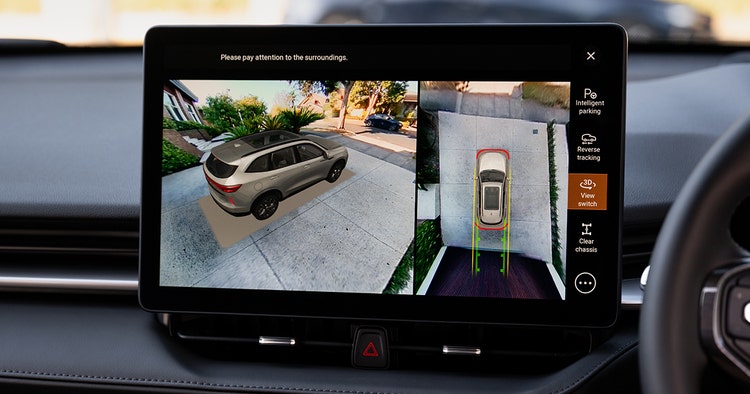
The new 14.6-inch infotainment screen is big, but underutilised thanks to the absence of a built-in sat-nav system (you can only bring your own via Android Auto or Apple CarPlay) and frustrating control clustering that hides commonly used functions, like the volume slider and ventilation controls.
Poor UX principles are also found on the 2025 GWM Haval H6’s steering wheel. Its reshaped rim is indeed nicer to hold now, but the arrow keys on the right side of the wheel are confusingly responsible for both the trip computer functions and audio. Their control mode is toggled by another button on the steering wheel, and there’s only a tiny visual indicator in the digital dash to tell you whether you’re in audio mode, or trip computer mode. Annoying.
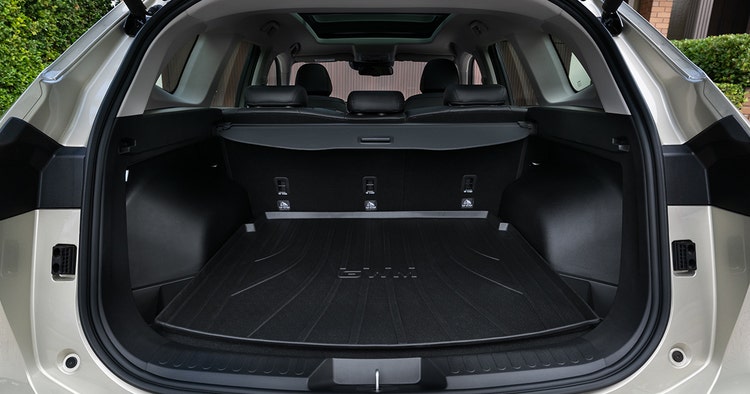
A bigger limitation is the absence of any clever packaging in the boot space. At 560L with the rear seats up it’s got enough capacity to be useful, but there’s no under-floor storage, nowhere to stow the cargo blind when it’s not in use and not even a single bag hook or cargo net to secure your groceries.
What is under the bonnet of the Haval H6 Ultra Hybrid?
While the cabin is littered with impressive tech, arguably the most impressive piece is under the bonnet.
The powertrain pairs together a 1.5-litre turbocharged petrol four-cylinder engine with an electric motor that drive the front wheels through a dedicated hybrid automatic transmission.
The petrol engine on its own produces 110kW and 230Nm while the electric motor adds 130kW/300Nm for maximum combined outputs of 179kW and 530Nm – which might just be too much of a good thing for the front-wheel drive H6 hybrid.
GWM does not quote any details for the conventional hybrid’s battery capacity or chemical make-up.
How fuel efficient is the Haval H6 Ultra Hybrid?
Hybrids are hot in SUV-land, and the H6’s 1.5-litre turbo-petrol and electric-motor combo promises some enticing numbers. Naturally, fuel economy is arguably the most important, and for the H6 Ultra hybrid, the factory claim for the combined cycle is 5.2L/100km (NEDC).
What is the Haval H6 Ultra Hybrid like to drive?
While the design team spent considerable effort improving the Haval H6’s aesthetics – both inside and out – the engineers have also had a crack at making the H6 drive better too.
Its predecessor suffered from a sloppy chassis and ho-hum handling, with most of the blame levelled at a suspension set-up that was too soft.
However, for this facelift, the dampers have been tightened up with stronger rebound force, which has resulted in significantly better body control. Good job.
Another positive note concerns its hybrid efficiency. Haval claims 5.2L/100km on the combined cycle, and that’s precisely what our tester delivered after subjecting it to our 100-kilometre urban/highway test loop. The extent of its electrification is also a high point, with the H6 hybrid having a stronger preference for pure-electric propulsion than many other petrol-electric hybrid SUVs.
But the Haval H6 is a case in point that there is a line in the sand where you can have too much power going through just the front wheels. With 530Nm of petrol-electric torque (that’s almost as much as any HSV had with a 6.0-litre V8), it’s too grunty for its own good and will incessantly spin-up a tyre under acceleration.
It’s worse when the road is wet and the traction control simply can’t reign it back and throws in the towel.
Actually, it’s not much better when it is working properly, as it attempts to control slippage by abruptly cutting power before restoring it after an uncomfortably long pause.
A fix should be simple; either reduce the overall torque output or re-shape the torque curve to make it more driveable. We hear there’s a new chassis tune coming for the H6, so fingers crossed it’s addressed then.
How much does the Haval H6 Ultra Hybrid cost to maintain?
All GWM Haval H6 model variants are covered by a standard seven-year unlimited kilometre warranty for non-commercial use, with the electric motor and battery pack guaranteed for eight years.
All owners are provided with five years of roadside assistance and capped price servicing with the first inspection due after 12 months or at 10,000km with longer 15,000km intervals each year after that.
The total cost for basic maintenance over the first five years adds up $2145.
Should I lease a Haval H6 Ultra Hybrid?
The value for money is hard to look past, especially as the updated 2025 Haval H6 Ultra hybrid looks smarter and functions better than ever. It rides nicer, too.
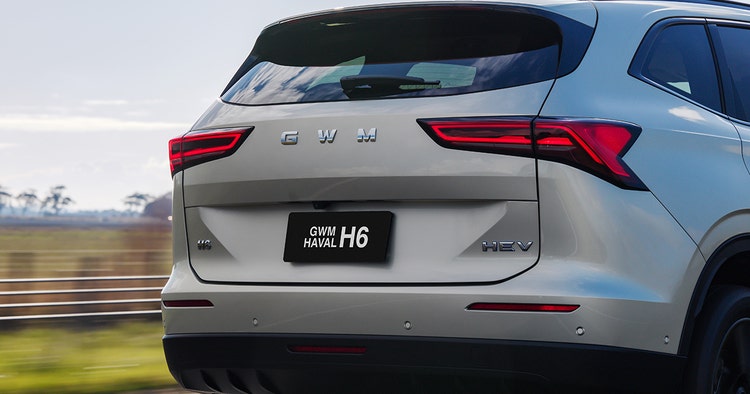
However, the ragged edges created by the over-abundance of torque from this surprisingly muscular hybrid family car means there’s still room for GWM Haval to improve the recipe and make it as pleasant to drive as its Japanese and European competition.
2025 GWM Haval H6 Ultra hybrid at a glance:
Editor’s Rating: 7.4/10
$43,990 (drive-away)
Now
1.5-litre four-cylinder turbo petrol-electric hybrid
110kW/230Nm (electric motor: 130kW/300Nm)
179kW/530Nm
DHT automatic
5.2L/100km (NEDC)
120g/km (ADR Combined or WLTP if overseas model)
Five-star (2022)
Disclaimer: Images supplied by GWM.
Explore GWM Haval Novated Leasing
A GWM Haval novated lease may help eligible employees package their car and running costs into one regular payment. Learn more about GWM novated leasing, how a novated lease works, and use our novated lease calculator to estimate your potential costs and savings.