

2025 Ford Ranger PHEV Stormtrak Review
How does the blue oval’s all-new petrol-electric ute stack up in flagship Stormtrak trim?

By carsales.com.au
Any new Ford Ranger is big news given its popularity and quality. But this one is particularly noteworthy.
The Ford Ranger PHEV is the first Ranger to break away from the diesel orthodoxy and embrace some form of zero-emissions future.
Ford also becomes the first legacy brand to respond to two Chinese plug-in ute interlopers that have generated significant interest and response since their recent launch.
The blue oval brand has made it clear the addition of battery power is to make light work of heavy-duty tasks rather than reducing the guilt of suburban warriors with decent EV range. Time to find out if it has struck the right balance.
How much does the Ford Ranger Stormtrak cost?
As its name suggests, the 2025 Ford Ranger PHEV adds a new petrol-electric powertrain to Australia’s most popular ute lineup.
It also adds a new model name, Stormtrak, which is the flagship of the plug-in range and the model we’ve ended up testing here.
The PHEV set-up is also available on three existing models with prices starting at $71,990 plus on roads for the entry-level XLT, rising to $75,990 plus on roads for the Sport and $79,990 plus on roads for the Wildtrak.
The Stormtrak tops them all at $86,990 plus on roads, which positions it between the full luxury Platinum and the desert-busting Raptor variants.
All PHEV versions command a serious premium over their diesel-powered equivalents (up to $10,350) partly because of the added complexity in the powertrain but also because they are sourced from South Africa which incurs a five percent import tariff whereas all other models are built in Thailand which has a free-trade agreement with Australia.
It is also substantially more expensive than the only other two plug-in hybrid utes currently available in Australia, the BYD Shark 6 which costs from $57,990 plus on roads and the GWM Cannon Alpha which starts at $59,990 plus on roads.
What standard equipment does the Ford Ranger Stormtrak feature?
As the flagship in the range, the 2025 Ford Ranger PHEV Stormtrak is unsurprisingly the best-equipped model.
Exclusive standard equipment includes ‘chill’ grey paint, a gloss-black grille with a honeycomb pattern and chill grey accents, gloss-black RANGER hood lettering, a gloss-black rear bumper and 18-inch alloy wheels with grey accents.
There are more grey-and-gloss-black accents inside the cabin including the Stormtrak-badged seats.
On a more practical level, the interior also adds auxiliary switches, and the load box gains Ford’s flexible rack and cargo management systems. Stormtrak is also the only Ranger PHEV to have a spare full-size tyre standard. It’s a no-cost option in the others so a slightly better payload (by about 30kg) can be claimed.
Stuff shared with cheaper Ranger PHEVs includes side steps, smart keyless entry, dual-zone climate control, leather seat trimming, eight-way powered and heated front seats, a power roller shutter, and illumination and a drop-in tub liner for the load box. A tow bar with an integrated trailer brake receiver is standard for all PHEVs.
Prestige paint adds $700 for all models bar the Stormtrak, and opting for 18-inch alloy wheels fitted with all-terrain tyres costs $700 for all four models. The standard Continental all-season tyres are better suited for road use.
When it comes to technology, the big deal with the 2025 Ford Ranger PHEV is the vehicle-to-load (V2L) capability provided by the high-voltage battery pack.
Called Pro Power Onboard, it comprises twin 3.45kW (15 amps at 230 volts) sockets in the tray and a single 2.3kW (10A at 230V) socket in the cabin.
Effectively, this system turns the Ranger PHEV into a portable generator that can charge work tools, camping equipment and the like. The Shark 6 and Cannon Alpha offer the same feature.
Equipment Ford tested the feature with during development included a 3000-watt angle grinder, an 1800W air-conditioner and a 1600W coffee maker.
Otherwise, Ranger PHEV technology aligns pretty much with the equivalent diesel variants. All models get the bigger 12-inch vertical infotainment screen, and the lower-spec 8-inch digital instrument panel. Not even the Stormtrak gets the 12.4-inch cluster seen in Platinum and Raptor V6s.
Otherwise, it’s familiar stuff. Apple CarPlay and Android Auto can be mirrored wirelessly (and usually – not always – quite seamlessly), satellite navigation is embedded, AM/FM and digital radio bands are standard and in the Stormtrak – as well as the Wildtrak – audio is broadcast via a 10-speaker B&O system.
Other Ranger Stormtrak technology includes wireless smartphone charging, four USB ports, voice control, ambient cabin lighting, puddle lamps and zone lighting and the FordPass Connect app communicating via an embedded modem. It delivers features like remote unlock – which can be very handy, as I know from hard experience!
What safety features does the Ford Ranger Stormtrak have?
All plug-in hybrid variants of the Ford Ranger have been given the same maximum five-star ANCAP rating as the diesel-powered siblings.
The safety equipment level across the range includes autonomous emergency braking, adaptive cruise control, lane keeping assistance, evasive steering and reverse braking assist, blind-spot monitoring, tyre pressure monitoring and front and rear parking sensors.
By the time you get to the Stormtrak, matrix LED headlights (with auto levelling and dynamic bending), traffic-sign recognition, lane centring, intelligent stop and go cruise control that can react to speed limit changes, a 360-degree camera and trailer reversing assistance have all been added.
There are also nine airbags – including front-centre – and two ISOFIX and two child seat top tethers in the rear seat.
What is the Ford Ranger Stormtrak like on the inside?
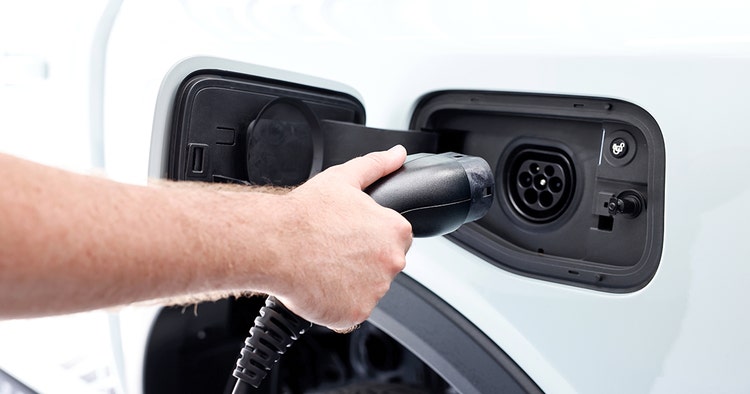
Just like it is on the outside – with the important exception of the extra charge port flap next to the fuel filler (don’t get them mixed up!) – there’s not much inside the cabin that defines the plug-in from other Ranger models.
Fundamentally that means you get one of the most comfortable and best-thought-out interiors on offer in ute-dom today.
Look, it can’t match the Chinese PHEVs for sheer opulence or pricing, but pretty much everything here (bar that clunky gear shifter) works without fuss.
The front seats are comfortable, the steering wheel has reach and rake adjustment, and there are physical as well as digital buttons for the air-con and audio volume.
The infotainment screen is huge and clear – especially if you use smartphone satnav graphics rather than Ford’s embedded system (which isn’t as crisp).
The instrument panel is still a compromised mish mash, with a couple of minor presentation retunes possible and heaps of pop-ups available to be selected. Some of the info is helpful, like tyre pressure monitoring, but it’s just clunky to drill through it all.
The rear seat gives up space, comfort and opulence to the Chinese PHEVs, but among legacy utes it’s a leader for space and equipment, including the aforementioned V2L plug.
The backrest folds down and the base flips up (with storage underneath) to aid versatility.
What is under the bonnet of the Ford Ranger Stormtrak?
The 2025 Ford Ranger PHEV combines a detuned version of the same 2.3-litre turbo-petrol engine found in the Mustang with an e-motor and an 11.8kWh high-voltage lithium-ion battery to deliver a combined 207kW and 697Nm.
That’s more torque than any other Ranger and more power than any Ranger besides the mighty twin-turbo V6 Raptor.
This is a longitudinal ‘P2’ set-up, which means the e-motor sits in the transmission tunnel between the engine and the 10-speed automatic gearbox.
Normal service is resumed further along the transmission with a BorgWarner torque-on-demand transfer case allowing rear-wheel drive, all-wheel drive, locked 50:50 4H courtesy of the centre diff, and low range.
The Ranger PHEV also includes a lockable rear differential and hill descent control.
There are four powertrain choices that are activated by a switch on the centre console. EV Now sees the Ranger run on battery power alone for short distances; Auto EV sees both the engine and the e-motor contribute to performance; EV Later preserves battery charge for later use; and EV Charge recharges the battery while letting the petrol engine do the work.
There are no fewer than seven selectable drive modes. Normal and slippery allow all four powertrain choices, eco excludes EV Charge, while sport, tow/haul, mud/ruts and sand only allow the full-fat hybrid mode.
All in all, this contributes to an official fuel consumption claimed average of 2.9L/100km and a maximum electric driving range of 49km.
One important factor to note is the battery pack is only rated for AC charging at a maximum of 3.5kW and takes around 4 hours to replenish.
Those battery and EV limitations do pay-off for the 2025 Ford Ranger PHEV when it comes to retaining its working ute functionality as it is undoubtedly the best PHEV ute on the market for being able to carry things.
Even the Stormtrak, the weakest performer in terms of payload at 808kg, carries more than either of the Chinese PHEVs. The best performer is the XLT at 973kg (that’s without a spare tyre though).
The high-voltage battery under the floor has prompted the load box to be raised by 27mm, but it’s also been lengthened via scallops up front and in the tailgate to compensate.
According to the tail of the tape, the load box now measures 1638mm long (at the floor), 1584mm wide and 498mm high. Crucially, the 1233mm gap between the wheel arches will accept a standard Aussie 1165mm x 1165mm pallet.
There are four hooks in the box, although the front ones are harder to access in the Stormtrak (and Wildtrak) because of the storage box for the power cover.
Corner steps aid access, but without any damping the tailgate crudely clangs open (that’s a feature also found in the cheaper Ranger Platinum diesel).
The gross vehicle mass has risen for the PHEV to 3500kg from the diesel dual-cab Ranger’s maximum 3350kg, reflecting a climb in kerb weight to as much as 2692kg for the Stormtrak.
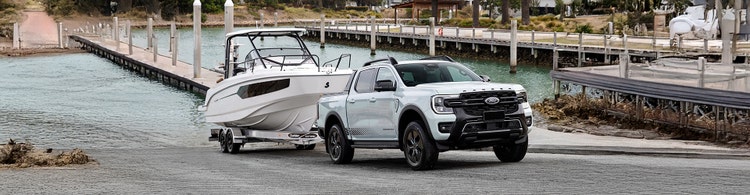
Gross combined mass has also climbed 180kg to 6580kg, helping to preserve the all-important 3500kg braked towing capacity.
Predictably, once the calculations are done, the Stormtrak has the least payload in the range at 388kg once a 3500kg load is hitched up. The XLT tops the list at 553kg.
The Cannon Alpha offers 335kg at the same weight while the BYD Shark 6 is only capable of towing 2500kg but does it well.
What is the Ford Ranger Stormtrak like to drive?
The 2025 Ford Ranger PHEV is a convincing ute but not much of an electric vehicle.
The short driving range on battery power alone is one issue but the limited response in EV mode is another that’s more immediately impactful.
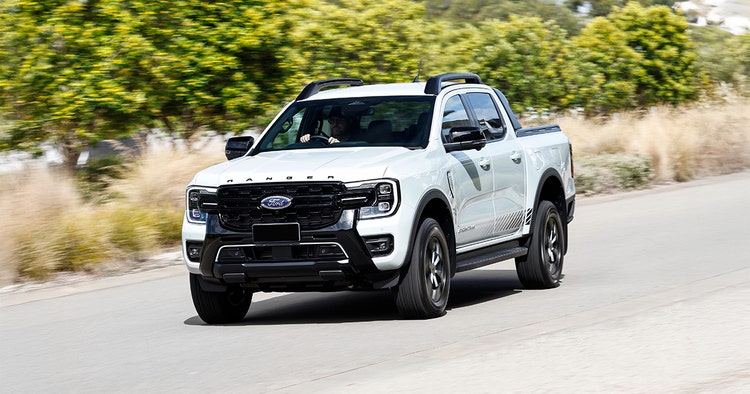
As an EV the Ranger PHEV is pretty much a dawdler. Any time substantial throttle demands are made – like when climbing a hill or overtaking – a message flashes up on the instrument cluster requesting permission to engage the petrol engine.
The Chinese PHEV utes don’t do that. Their petrol engines kick in when needed. But Ford says if you’re in EV mode then you have to consciously leave it.
When permission is granted, things change dramatically. This is a strong combination that leaves nothing lacking compared to the Ranger diesels, which are two of the best in the business. In fact, it’s arguably smoother, quieter and more refined.
Beyond the powertrain the added weight of the Ranger PHEV makes itself felt in the way it proceeds along the road.
Bearing in mind the vehicle wasn’t carrying a load, the rear leaf-spring/live-axle suspension felt stiffer and more intrusive than the more compliant diesel Ranger.
A bespoke and presumably stiffer tyre (fitted to a wider rim) designed to cope with the PHEV’s heavier weight likely contributes to this as well.
Similarly, the electric-assist steering felt like it required more effort than the diesel Rangers, which are at the lighter end of the scale compared to just about any other dual-cab ute.
Also, brake pedal feel was pretty wooden, probably made more than normal because of the regenerative braking effect incorporated into the system. It became quite grabby as the vehicle slowed to walking pace.
There is no driver adjustment of the brake regen effect, which would seem to be a miss.
Other aspects of the Ranger PHEV are familiar: the sympathetically tuned driver assist systems, which work for the most part unobtrusively and supportively and can be switched off easily.
Less positive is how the gearshift is easy to wrong slot and the oddly placed rocker switches on the shifter’s side for manual gear changing.
With something so torque laden that’s not such a big deal, but a proper manual mode would be appreciated.
The launch drive of the 2025 Ford Ranger PHEV really emphasised its undiminished 4x4 capability.
There were two distinct sets of exercises at two off-road locations, where the 4x4 system’s ability to ascend and descend was basically unchallenged, and in some cases even improved over the diesel variants.
Tip-in throttle was basically instant thanks to the e-motor’s instant torque, while the low-range traction control operating on the front wheels when the rear diff was locked seemed smoother, more prompt and more subtle.
Check out the key measures and the PHEV comes with the same 800mm wading depth and 12.9m turning circle as the Ranger diesels but slightly less ground clearance.
Whereas most diesel-powered Rangers have 234mm of clearance, the PHEVs range from 215mm on the XLT up to 228mm on the Sport (Wildtrak and Stormtrak have 226mm). Breakover angles are slightly reduced as well.
Ford claims as little as 28.9 degrees approach/23.9 degrees departure for the XLT PHEV, 30.1/24.7 degrees for the Sport and 30.2/24.2 degrees for the Wildtrak and Stormtrak PHEVs; the claim for diesel-powered Rangers is 30 degrees and 23 degrees.
The PHEV adds additional underbody armouring to protect the high-voltage battery and parts of the transmission.
How much does the Ford Ranger Stormtrak cost to maintain?
The PHEV models receive the same five-year/unlimited-kilometre warranty as other Rangers and adds eight year/160,000km protection for its high-voltage battery.
Service intervals are 12 months or 15,000km, whichever comes first, and the first five visits to the dealer workshop are capped at $399. That compares to a maximum $379 per visit for diesel Rangers.
Should I lease a Ford Ranger Stormtrak?
Ford emphasises how much effort went into customer research for the Ford Ranger PHEV. That’s why it ended up so focussed on retaining working capability.
That comes at the expense of its EV capability of course, which means it’s not much of an electric car. But it remains a very good tool of trade vehicle.
If you’re a ute buyer looking for maximised EV running, then the Chinese duo are going to mount a strong argument. They are better EVs but not as capable as work utes.
Surely this means the Ranger PHEV is going to primarily appeal to fleet buyers who have corporate CO2 reduction targets to hit. It will also help Ford score much-needed credits under the NVES CO2 reduction scheme.
For private buyers – unless you’re committed to zero-emissions running and some long-term fuel efficiency gains (maybe) – the cheaper diesel Ranger, especially the V6, remains the best choice.
2025 Ford Ranger PHEV Stormtrak at a glance:
Editor’s Rating: 7.4/10
$86,990 (plus on-road costs)
Now
2.3-litre four-cylinder turbo petrol-electric
138kW/411Nm (electric motor: 75kW/torque unstated)
207kW/697Nm
10-speed automatic
11.8kWh lithium-ion
49km EV (ADR)
18.7kWh/100km (ADR)
2.9L/100km (ADR Combined)
66g/km (ADR Combined)
Not tested
Disclaimer: Images supplied by carsales
Explore Ford Ranger Novated Leasing
A Ford Ranger novated lease may help eligible employees package their car and running costs into one regular payment. Learn more about Ford novated leasing, how a novated lease works, and use our novated lease calculator to estimate your potential costs and savings.